A 10-port Level 2 charging project at a commercial property runs $80,000–$120,000 before incentives. After stacking the right combination of federal, state, and utility programs, that same project can cost 50–78% less. The gap between paying full price and capturing every available dollar comes down to knowing which programs exist in your state, how they layer together, and when they expire.
This guide covers EV charging incentives by state for commercial property owners, facility managers, and fleet operators. We break down the federal 30C tax credit (expiring June 30, 2026), the $5 billion NEVI infrastructure program, the highest-value state programs, and a step-by-step approach to stacking multiple incentives on a single installation.
Contents
- 1 The Federal 30C Tax Credit: Your Baseline Incentive
- 2 The NEVI Program: $5 Billion in Federal Infrastructure Funding
- 3 Top States for Commercial EV Charging Incentives
- 4 How to Stack Federal, State, and Utility Incentives
- 5 What Commercial EV Charging Actually Costs Before Incentives
- 6 Technical Requirements That Affect Incentive Eligibility
- 7 How to Claim the 30C Federal Tax Credit
- 8 Key Deadlines for 2026
- 9 Frequently Asked Questions
- 9.1 What EV charging incentives are available in my state?
- 9.2 Can I combine federal and state EV charging incentives on the same project?
- 9.3 Does the 30C tax credit apply to residential EV charger installations?
- 9.4 What happens after the 30C tax credit expires in June 2026?
- 9.5 Do I need specific charger brands to qualify for state incentives?
- 10 Turn Incentives Into Installed Chargers
The Federal 30C Tax Credit: Your Baseline Incentive
The Section 30C Alternative Fuel Infrastructure Tax Credit is the single most valuable federal incentive for commercial EV charging installations. Extended under the Inflation Reduction Act and recently shortened by the One Big Beautiful Bill Act, it covers up to $100,000 per charging port for businesses, calculated as a percentage of hardware and installation costs.
The percentage depends on labor compliance. Meet prevailing wage and apprenticeship requirements (installers paid at local prevailing rates, apprentices completing at least 15% of labor hours), and you claim the full 30%. Skip those requirements, and the credit drops to 6%. For a DC fast charger costing $150,000 installed, that’s the difference between a $45,000 credit and a $9,000 credit.
Eligibility Requirements
Not every property qualifies. The charging equipment must be installed in an eligible census tract — areas where the poverty rate is at least 20%, or the median family income falls below 80% of the state median. The Argonne National Laboratory’s 30C Tax Credit Eligibility Locator lets you check your site address before committing to a project.
Equipment must be new, permanently installed, and used for business or public purposes. Portable chargers don’t qualify. Each charging port counts as a separate item of property for credit calculation purposes.
The June 2026 Deadline
The 30C credit expires June 30, 2026. Equipment must be placed in service — operational and available for use — by that date. Not just ordered. Not just contracted. Installed and working. A typical commercial EV charging project takes 4–8 months from planning to energization when you factor in permitting, utility coordination, and construction. If you haven’t started the process, the window is closing. To understand the full scope of what’s involved, see our commercial EV charging installation cost breakdown.
The NEVI Program: $5 Billion in Federal Infrastructure Funding
Most incentive guides skip the National Electric Vehicle Infrastructure program entirely. That’s a significant blind spot. NEVI is the largest dedicated EV charging funding program in U.S. history, allocating $5 billion through FY2026 under the Bipartisan Infrastructure Law. Unlike the 30C credit, NEVI funds flow through state transportation departments, which run their own application and award processes. The federal government covers up to 80% of eligible project costs — hardware, installation, and network connectivity included.
Where NEVI Stands in 2026
The program hit serious turbulence in early 2025 when the FHWA froze new state funding during a regulatory review. A coalition of 16 states and D.C. challenged the freeze in court. On January 23, 2026, Judge Tana Lin of the U.S. District Court for the Western District of Washington issued an injunction preventing the FHWA from suspending approved state deployment plans or withholding NEVI formula funds.
With funding restored, states are moving again. As of early 2026, $3.3 billion has been allocated to states, with approximately $670 million awarded to specific projects. The FY2026 apportionment added $885 million. However, a pending FY2026 appropriations bill proposes transferring $879 million in NEVI funds to other FHWA programs — a development worth watching closely.
On the ground, 44 states have released at least one NEVI funding solicitation, though only 384 ports had been built through the program as of late 2025. The pace is expected to accelerate through 2026 as awarded projects reach completion.
States Currently Accepting NEVI Applications
Nine states have open or recently opened NEVI funding rounds: Arizona, California, Colorado, Illinois, Maine, New Mexico, Ohio, Oregon, Pennsylvania, and Washington. Another 12 states — Alabama, Kentucky, Maryland, Montana, Nevada, New Hampshire, North Carolina, North Dakota, South Carolina, Utah, Vermont, and Virginia — plus D.C., are planning upcoming rounds.
The funding numbers are substantial. Pennsylvania is receiving $171.5 million over five years and opened its first Community Charging round in February 2026. California’s allocation is $384 million. New York will receive approximately $175 million. For the full details on contractor requirements and how to position your business for NEVI projects, see our NEVI program guide.
EV Charging Incentives by State: Full Reference Table (2026)
| State | Program(s) | Incentive Type | Commercial Amount | Eligible Property Types | Status (Q1 2026) |
|---|---|---|---|---|---|
| Alabama | Alabama Power utility rebate | Utility rebate | Up to $500/port (L2); varies by rate class | Residential, small commercial | Active; NEVI solicitation planned |
| Alaska | Chugach Electric Association; Alaska Power & Telephone | Utility bill credit/rebate | $200 bill credit/charger (Chugach); $500 rebate (AP&T) | Residential; small commercial | Active (utility-level) |
| Arizona | Arizona Commerce Authority EVSE grants; APS & SRP utility programs | State grant + utility rebate | Varies; NEVI open solicitation for corridor DCFC | Public access, workplace, fleet | Active; NEVI Round open |
| Arkansas | Entergy Arkansas utility rebate | Utility rebate | Up to $500/port (L2) | Residential; limited commercial | Active (utility-level) |
| California | PG&E / SCE / SDG&E make-ready programs; CARB Clean Vehicles Rebate | Utility make-ready + state grant | Varies by utility; make-ready covers full electrical upgrade cost at qualifying sites | All types; DAC/low-income prioritized | Active; ongoing utility programs |
| Colorado | Charge Ahead Colorado (CDPHE); Xcel Energy / Black Hills rebates | State grant + utility rebate | Up to 80% of total cost (DCFC, public access); $500–$1,800 utility (L2) | Public access, fleet, workplace | Active |
| Connecticut | CT Green Bank EVSE grants; Eversource / UI utility programs | State grant + utility rebate | Up to $10,000/port (CT Green Bank commercial); utility programs vary | Commercial, multifamily, public | Active |
| Delaware | Delmarva Power; Delaware Clean Vehicle Rebate Program | Utility rebate | Up to $500/port (residential L2); commercial programs limited | Residential; limited commercial | Active (utility-level) |
| Florida | Duke Energy / FPL / TECO utility programs; NEVI corridor funding | Utility rebate + NEVI | Utility rebates: up to $500–$1,000/port (L2); NEVI DCFC corridor focus | Public access (NEVI); residential/small commercial (utility) | Active (utility-level); NEVI underway |
| Georgia | Georgia Power utility EV programs; NEVI corridor funding | Utility rebate + NEVI | Georgia Power Make-Ready: covers infrastructure costs for qualifying sites | Workplace, multifamily, public | Active |
| Hawaii | Smart Charge Hawaii (Hawaiian Electric); HECO utility programs | Utility rebate + managed-charging incentive | $150 enrollment incentive; hardware discounts; rate incentives | Residential; limited commercial | Active |
| Idaho | Idaho Power utility rebate; Rocky Mountain Power | Utility rebate | Up to $500/port (L2, residential/small business) | Residential, small commercial | Active (utility-level) |
| Illinois | IL EPA EVSE Grant Program; ComEd utility programs | State grant + utility rebate | Up to $70,000/site (DCFC); ComEd: up to $10,000/site (workplace) | Public, workplace, multifamily, fleet | Active; NEVI open |
| Indiana | Indiana Utility Regulatory Commission; AES / Duke Indiana programs | Utility rebate | Varies by utility; commercial programs are limited | Residential; limited commercial | Active (utility-level) |
| Iowa | MidAmerican Energy / Alliant Energy utility rebates | Utility rebate | Up to $500/port (L2) | Residential, small commercial | Active (utility-level) |
| Kansas | Westar / Evergy utility rebate | Utility rebate | Up to $500/port (residential); commercial limited | Residential; limited commercial | Active (utility-level) |
| Kentucky | LG&E / KU utility programs; NEVI planning | Utility rebate | Up to $500/charger (residential); limited commercial | Residential; commercial limited | Active; NEVI solicitation planned |
| Louisiana | Entergy Louisiana / Cleco utility programs; state income tax credit (residential) | Utility rebate + state tax credit | Up to $1,500 state tax credit (residential); utility varies | Residential; limited commercial | Active (limited commercial) |
| Maine | Efficiency Maine (suspended except for low-income); Central Maine Power | Utility rebate | Programs largely suspended as of Nov 2024 (except low-income); utility programs active | Low-income residential only (state); commercial via utility | Suspended (state); utility active; NEVI open |
| Maryland | Maryland EVSE Rebate Program (MEA) | State rebate | Up to $5,000/charger; 50% of costs; $125,000/entity/year; $2.5M FY2026 pool | Commercial, multifamily, public | Active; FY2026 funding limited |
| Massachusetts | MassEVIP: 28 utility programs (Eversource, National Grid, etc.) | State grant + utility rebate | $100–$750/port (utility L2) + make-ready grants; higher for fleet/multifamily | Workplace, multifamily, fleet, public | Active |
| Michigan | Consumers Energy EVITP; DTE Energy EV+ program | Utility make-ready + rebate | Consumers: make-ready infrastructure coverage; DTE: up to $2,500/port (commercial) | Commercial, workplace, multifamily | Active |
| Minnesota | MN Dept of Commerce EV rebate; Xcel Energy / Minnesota Power programs | State rebate + utility rebate | Up to $500/L2 port (MN Power special rate); Xcel: commercial make-ready programs | Residential (utility); commercial via Xcel | Active |
| Mississippi | Entergy Mississippi, limited state programs | Utility rebate | Up to $500/port (residential); commercial very limited | Residential; minimal commercial | Limited |
| Missouri | Ameren Missouri / Evergy utility programs; Clean Energy Fund | Utility rebate | Up to $500–$1,000/port (L2); limited commercial grants | Residential, small commercial | Active (utility-level) |
| Montana | Northwestern Energy utility programs; NEVI planning | Utility rebate | Limited; NEVI corridor focus | Public access (NEVI); residential (utility) | Limited; NEVI solicitation planned |
| Nebraska | Nebraska Public Power District; OPPD programs | Utility rebate | Up to $500/port (residential); limited commercial | Residential; limited commercial | Active (utility-level) |
| Nevada | NV Energy EV programs; Nevada Governor’s Office of Energy | Utility make-ready + state grant | NV Energy: make-ready infrastructure for commercial; up to $2,500/port | Commercial, multifamily, workplace | Active; NEVI solicitation planned |
| New Hampshire | NH DOT NEVI planning; Eversource NH programs | Utility rebate | Eversource: up to $1,000/port (L2 commercial); NEVI corridor focus | Commercial, public (NEVI) | Active (utility); NEVI planned |
| New Jersey | NJBPU EV Charging Incentive Program; PSE&G / JCP&L utility programs | State grant + utility make-ready | Up to $250,000/site (DCFC, public access); PSE&G make-ready covers infrastructure | Public access, commercial, multifamily | Active |
| New Mexico | NM Energy, Minerals and Natural Resources Dept; PNM utility | State grant + utility rebate | Varies; NEVI open solicitation | Public, commercial, multifamily | Active; NEVI open |
| New York | Charge Ready NY 2.0 (NYSERDA) | State rebate | $3,000/port standard; $4,000/port in DACs; $1,000/port (assigned/fleet); $28M total pool | Workplace, multifamily, hotel | Active; $15M added Feb 2026 |
| North Carolina | Duke Energy Progress / Duke Energy Carolinas make-ready; NEVI | Utility make-ready + NEVI | Duke make-ready: covers electrical infrastructure for commercial; NEVI corridor DCFC | Commercial, public (NEVI) | Active; NEVI solicitation planned |
| North Dakota | Montana-Dakota Utilities; Basin Electric; NEVI planning | Utility rebate | Limited; NEVI corridor focus | Public access (NEVI) | Limited; NEVI planned |
| Ohio | AEP Ohio / FirstEnergy utility programs; Ohio NEVI funding | Utility rebate + NEVI | AEP: up to $1,000/port (L2 commercial); NEVI: open solicitation for corridor DCFC | Commercial, public (NEVI) | Active; NEVI open |
| Oklahoma | Oklahoma Gas & Electric utility programs; limited state incentives | Utility rebate | Up to $500/port (residential); limited commercial | Residential; limited commercial | Limited |
| Oregon | ODOT Community Charging Rebates; PGE commercial incentive; Pacific Power | State grant + utility rebate | Up to $8,000/port at 80% (ODOT); up to $25,500/port (PGE); up to $1,000/port (Pacific Power) | Multifamily, workplace, public, fleet | ODOT Round 4 closed Jan 2026; future rounds expected; PGE active |
| Pennsylvania | NEVI Community Charging (Round 1, Feb 2026); PECO / PPL utility | NEVI grant + utility | NEVI: up to 80% of project cost; $171.5M state allocation; utility programs vary | Public, community, workplace | Active; NEVI Round 1 open |
| Rhode Island | DRIVE EV (RI); National Grid RI utility programs | State rebate + utility | DRIVE EV: up to $2,500 (new EV focus); National Grid: commercial charger incentives vary | Residential focus; commercial via utility | Active |
| South Carolina | Duke Energy SC; Dominion Energy SC programs; NEVI planning | Utility rebate + NEVI | Duke make-ready: covers electrical infrastructure; NEVI corridor focus | Commercial, public (NEVI) | Active (utility); NEVI solicitation planned |
| South Dakota | Basin Electric, Black Hills Energy programs, and limited state incentives | Utility rebate | Very limited; NEVI corridor focuses only | Public access (NEVI) | Limited |
| Tennessee | TVA EV programs; Nashville Electric Service; NEVI | Utility rebate + NEVI | TVA: up to $500/port (L2); NEVI corridor DCFC funding | Residential (TVA); public (NEVI) | Active (utility); NEVI underway |
| Texas | Oncor / CenterPoint / AEP Texas utility programs; NEVI ($408M allocation) | Utility rebate + NEVI | Utility: up to $500–$1,500/port; NEVI: $408M for corridor DCFC (largest single-state allocation) | Public access (NEVI); residential/small commercial (utility) | Active (utility); NEVI underway |
| Utah | Rocky Mountain Power utility programs; NEVI planning | Utility rebate + NEVI | Rocky Mountain Power: up to $1,500/port (commercial); NEVI corridor focus | Commercial, public | Active; NEVI planned |
| Vermont | Efficiency Maine — programs suspended; Green Mountain Power utility | Utility rebate | GMP: up to $500/port (L2); state programs largely closed to new applicants | Residential; limited commercial via GMP | State programs suspended; utility active |
| Virginia | Dominion Energy EV Charger Rebate; NEVI planning; state EV rebate program | Utility rebate + state rebate + NEVI | Dominion: up to $1,000/port (L2 commercial); state: up to $2,500 rebate; NEVI planned | Commercial, multifamily, public | Active; NEVI solicitation planned |
| Washington | WAEVCP Round 2 (WA Dept of Commerce); Puget Sound Energy programs | State grant + utility | $5,000–$12,500/L2 port; $150,000/DCFC port; $19.4M total pool (Round 2 closed Dec 2025) | Public, workplace, fleet, multifamily | Round 2 closed; Round 3 anticipated |
| West Virginia | Mon Power / Appalachian Power utility programs; NEVI | Utility rebate + NEVI | Limited utility rebates; NEVI corridor funding | Public access (NEVI) | Limited; NEVI underway |
| Wisconsin | Focus on Energy (WI); We Energies / Xcel Energy WI programs | State program + utility | Focus on Energy: up to $2,500/port (commercial L2); utility programs vary | Commercial, multifamily, workplace | Active |
| Wyoming | Rocky Mountain Power, Wyoming; limited state incentives; NEVI | Utility rebate + NEVI | Very limited state programs; NEVI corridor DCFC focus | Public access (NEVI) | Limited; NEVI underway |
Table notes: Amounts reflect commercial/public-access programs where available; residential programs may differ. “DAC” = Disadvantaged Community. Verify all programs directly with the administering agency before applying — funding windows open and close throughout the year. All states remain eligible for the federal 30C tax credit on qualifying installations through June 30, 2026.
Top States for Commercial EV Charging Incentives
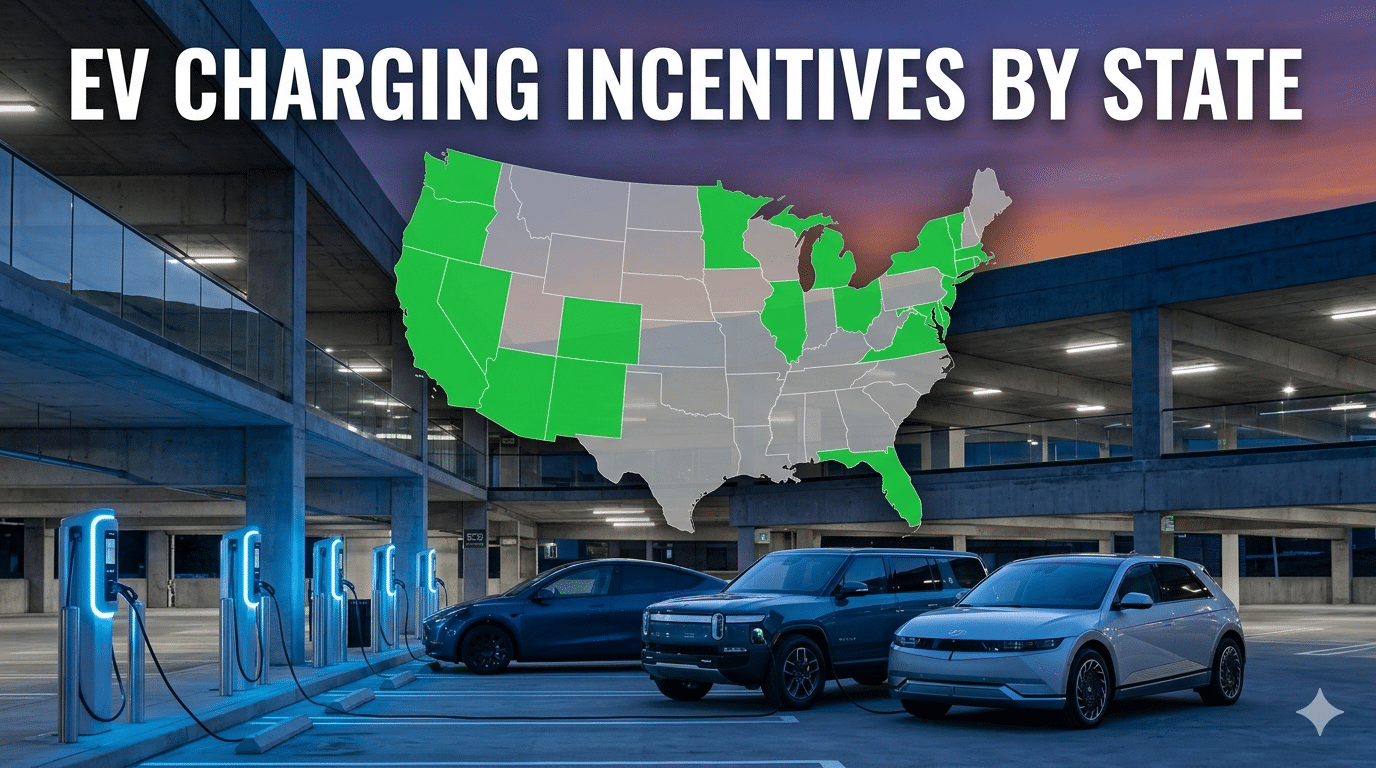
Over 70% of the U.S. is covered by some form of EV charger rebate or incentive program. But the value varies dramatically by state. The table below summarizes programs across all 50 states — use it as a starting point reference, then verify current details with your state energy office or utility before committing to a project timeline. Programs open and close throughout the year as funding pools are exhausted.
Oregon
Oregon runs one of the most aggressive state-level programs. The ODOT Community Charging Rebates Program (Round 4) offered up to $8,000 per port at 80% of project costs for multifamily, workplace, and public charging sites. That round closed January 20, 2026, but future rounds are expected, given continued VW settlement funding. On the utility side, Portland General Electric offers incentives reaching up to $25,500 per charging port for qualifying commercial projects — one of the highest utility-level incentives in the country. Pacific Power adds up to $1,000 per port at 75% of costs.
New York
The Charge Ready NY 2.0 program, administered by NYSERDA, provides $3,000 per Level 2 charging port for workplaces, multifamily properties, and hotels. Properties in Disadvantaged Communities qualify for an additional $1,000 per port, bringing the total to $4,000. Assigned or fleet-only spaces receive $1,000 per port. As of February 2026, NYSERDA added $15 million to the program, bringing total funding to $28 million.
Washington
The Washington Electric Vehicle Charging Program (WAEVCP) Round 2 awarded at least $19.4 million, funded by the Climate Commitment Act. Incentive amounts ran $5,000–$12,500 per Level 2 port and $150,000 per DC fast charging port — among the highest per-port amounts in the country. Round 2 applications closed in December 2025, but the state’s clean transportation funding pipeline suggests future rounds.
California
California’s incentive landscape is fragmented across dozens of utility-specific programs rather than a single statewide grant. The major IOUs (PG&E, SCE, SDG&E) each run make-ready infrastructure programs that cover electrical upgrades — often the most expensive part of a commercial installation. Low-income and disadvantaged community sites receive priority and higher funding levels. The Clean Cars 4 All program can provide up to $2,000 for EV charging infrastructure for qualifying participants.
Maryland
Maryland’s EVSE Rebate Program offers up to $5,000 per commercial charger, covering 50% of acquisition and installation costs. Each entity can receive up to $125,000 per fiscal year. The FY2026 budget is $2.5 million, with $1.0 million initially reserved for commercial applications. After April 1, 2026, those allocation limits lift — so timing your application matters.
Massachusetts
Massachusetts takes a distributed approach: 28 utilities across the state offer Level 2 charger rebates ranging from $100 to $750, with many covering both charger hardware and electrical work. The statewide MassEVIP program adds make-ready grants for workplaces, multifamily buildings, fleet facilities, and public-access sites. The combination of utility and state programs can stack to meaningful per-port savings.
For help deciding between Level 2 and DC fast charging for your property type, see our Level 2 vs. DC fast charging comparison.
Figuring out which incentives apply to your specific property type and location is the kind of assessment a qualified installer handles during a site survey. Search for commercial EV charging installers in your area to get the conversation started.
How to Stack Federal, State, and Utility Incentives
The biggest financial opportunity most property owners miss isn’t any single program — it’s the ability to combine them. The federal 30C credit does not disqualify you from state rebates or utility programs. When layered correctly, stacking can cut total project costs by 50–78%.
Worked Example: 4-Port Level 2 Installation in New York
| Line Item | Amount |
|---|---|
| Total project cost (hardware + installation + permitting) | $45,000 |
| Federal 30C tax credit (30% with prevailing wage compliance) | −$4,000 (capped at $1,000/port × 4) |
| Charge Ready NY 2.0 rebate ($3,000/port × 4) | −$12,000 |
| Utility make-ready program (electrical infrastructure) | −$6,000 (estimated) |
| Net cost to property owner | $23,000 |
| Effective cost reduction | 49% |
In states like Oregon, where utility incentives alone can reach $25,500 per port through PGE, the reduction climbs well past 60% for qualifying projects. Add a utility managed-charging enrollment that provides ongoing bill credits, and the long-term economics shift even further.
Stacking Rules to Follow
- Apply for state and utility programs first. Many have limited funding pools that close when exhausted. Federal tax credits are claimed on your return and aren’t capacity-limited.
- Document everything. Keep invoices, permits, contractor certifications, and proof of prevailing wage compliance. Both the IRS and state agencies audit claims.
- Check for pre-approval requirements. Many state programs require approval before you purchase equipment or begin installation. Starting work early can disqualify your project entirely.
- Verify census tract eligibility for 30C. A property one block outside an eligible tract gets zero federal credit. Use the Argonne locator tool before committing.
What Commercial EV Charging Actually Costs Before Incentives
Incentive percentages are meaningless without knowing the baseline. Here’s what commercial installations typically cost in 2026:
- Level 2 (commercial): $3,000–$12,000 per port installed, depending on electrical capacity, panel distance, and local permitting requirements.
- DC fast charging: $70,000–$200,000 per port installed, including transformer upgrades, demand charge infrastructure, and site preparation.
- Make-ready infrastructure: Trenching, conduit, panel upgrades, and utility service extensions often add $5,000–$25,000+ per site, especially for older buildings that weren’t designed with EV loads in mind.
For a multifamily complex planning 8–12 Level 2 ports, total project costs typically land between $40,000 and $120,000 before incentives. A fleet depot adding four DC fast chargers might face $400,000–$800,000. These are the numbers that make incentive stacking a financial priority rather than a nice-to-have. For a detailed cost walkthrough, see our commercial installation cost guide.
Technical Requirements That Affect Incentive Eligibility
Buying the wrong equipment can disqualify your project from incentives before you ever submit an application. Several technical standards are becoming baseline requirements across state programs.
OCPP 2.0.1 Compliance
States are increasingly requiring Open Charge Point Protocol (OCPP) 2.0.1 compliance for incentive-eligible chargers. OCPP is a communication standard that lets chargers connect with different network management platforms — meaning you’re not locked into a single vendor’s ecosystem. Version 2.0.1 adds security improvements, smart charging capabilities, and grid integration support that utilities need for demand management.
For property owners, this creates two practical rules: verify that any charger you purchase supports OCPP 2.0.1 before applying for incentives, and choose networked chargers over non-networked units even if the upfront cost is higher. Non-networked chargers are increasingly ineligible for state programs and miss out on managed-charging revenue.
Other Common Requirements
- Uptime mandates: NEVI-funded stations must maintain 97% uptime. Some state programs impose similar reliability thresholds.
- Public access: Many programs require chargers to be publicly accessible — not restricted to tenants or employees only.
- Minimum power output: NEVI requires at least 150 kW per DC fast charging port. State programs may set their own minimums.
- ADA compliance: At least one charging space per station must meet accessibility standards.
Before purchasing any hardware, check your target incentive program’s technical specs. Our contractor checklist for commercial installs covers the full list of items to verify.
How to Claim the 30C Federal Tax Credit
The 30C credit is claimed on your federal tax return using IRS Form 8911. Here’s the process:
- Verify location eligibility. Use the Argonne National Laboratory 30C Eligibility Locator to confirm your property is in a qualifying census tract.
- Select qualifying equipment. The charger must be new, permanently installed, and used for business or public purposes.
- Meet labor requirements for the full 30%. Ensure your contractor pays prevailing wages and uses apprentices for at least 15% of labor hours. Document this — the IRS will want proof.
- Complete installation before June 30, 2026. The equipment must be placed in service — operational and available for use — by the deadline.
- File Form 8911 with your tax return. Report each charging port as a separate item of property. Attach documentation of costs, location eligibility, and labor compliance.
The credit offsets tax liability dollar-for-dollar. If your business doesn’t have sufficient liability to absorb the full credit, consult a tax advisor about whether a direct-pay election or transferability option applies to your situation.
Costs vary significantly by property type, location, and utility territory. Request a quote from qualified commercial EV charging installers to get numbers specific to your building.
Key Deadlines for 2026
| Program | Deadline | What It Means |
|---|---|---|
| 30C Federal Tax Credit | June 30, 2026 | Equipment must be installed and operational by this date |
| NEVI FY2026 Funds | Varies by state | States setting their own solicitation windows; check your state DOT |
| State rebate programs | Varies; many have quarterly windows | Funding pools are limited and close when exhausted |
| Utility make-ready programs | Ongoing; budget-dependent | Apply early — utility budgets reset annually and fill fast |
The most time-sensitive incentive is the 30C credit. With a 4–8 month typical timeline for commercial installations, properties that haven’t started planning risk missing the June 2026 cutoff entirely.
Frequently Asked Questions
What EV charging incentives are available in my state?
Every state offers some form of EV charging incentive, though the value and structure vary widely. Over 70% of the U.S. is covered by charger-specific rebate programs from state agencies, utilities, or both. The AFDC Laws and Incentives database and ChargePoint’s incentive finder let you search by location and property type.
Can I combine federal and state EV charging incentives on the same project?
Yes. The federal 30C tax credit does not disqualify you from state rebates or utility programs. You can layer all three — federal credit, state grant, and utility rebate — on a single installation, reducing total costs by 40–78% depending on your state and property type.
Does the 30C tax credit apply to residential EV charger installations?
Yes, but the cap is much lower. Residential installations receive up to $1,000 (30% of costs), while commercial installations can claim up to $100,000 per port. Both require the property to be in an eligible census tract.
What happens after the 30C tax credit expires in June 2026?
Unless Congress passes new legislation, the federal tax credit for EV charging equipment ends. State and utility programs would remain active where they exist, but the most valuable single federal incentive disappears. No extension has been announced as of March 2026.
Do I need specific charger brands to qualify for state incentives?
Most programs are brand-agnostic but require specific technical standards — particularly OCPP 2.0.1 compatibility, network connectivity, and minimum power output. Check your state program’s technical requirements before purchasing hardware.
Turn Incentives Into Installed Chargers
The incentive landscape for commercial EV charging is the most favorable it’s been — and several of the biggest programs have firm expiration dates. The 30C federal credit disappears in June 2026, state program funding pools drain on a first-come basis, and NEVI dollars are actively being awarded to projects that are ready to build.
The first step is a site assessment from a qualified commercial EV charging installer who understands your state’s incentive programs and can map out which credits, rebates, and grants apply to your specific property. Find EV charging installers near you to get a site assessment on the calendar.
If you’re planning for a multifamily property specifically, our apartment complex EV charging guide covers the unique considerations for that property type.