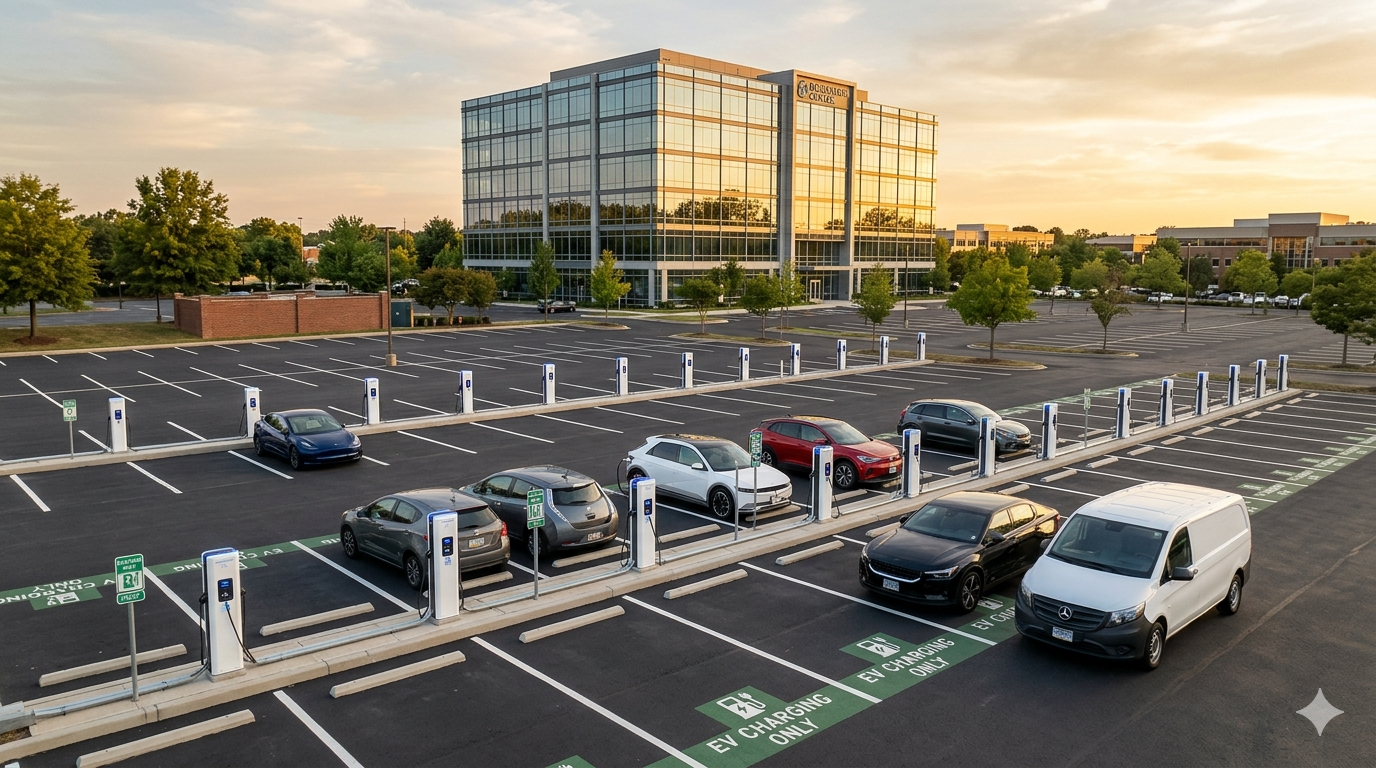
A 10-port Level 2 installation in an office parking lot runs $40,000–$90,000 before incentives. A single DC fast charger port can top $250,000 — and neither figure accounts for the transformer upgrade your utility may require before a shovel hits the ground.
Those gaps between estimate and reality are what this guide is designed to close. We’ll break down installation costs by charger type and property category, spell out the line items most contractors don’t flag upfront, and show you how federal and state incentives can cut net project costs by 30–60%, depending on where your property sits.
This is a guide for property managers overseeing 50+ unit complexes, facility directors managing multi-building campuses, fleet operators planning depot electrification, and commercial building owners evaluating EV charging as a tenant amenity. If you’re looking for help with residential charging, you’re in the wrong place.
Find certified commercial EV charging contractors near you →
Contents
- 1 How Much Does Commercial EV Charging Installation Cost?
- 2 Level 2 or DC Fast Charging: Which Does Your Property Actually Need?
- 3 Cost Breakdown by Property Type
- 4 The Line Items That Blow Most EV Charging Budgets
- 5 Federal and State Incentives That Cut Your Actual Cost
- 6 What’s the ROI on Commercial EV Charging?
- 7 How to Get an Accurate Quote — Not Just a Ballpark
- 8 Find Contractors Who Actually Know Commercial Projects
- 9 Frequently Asked Questions
- 9.1 How much does it cost to install a commercial EV charging station?
- 9.2 What factors most affect commercial EV charging installation costs?
- 9.3 Are there tax credits for commercial EV charging stations?
- 9.4 How much does a DC fast charger cost to install?
- 9.5 How long does a commercial EV charging project take from start to finish?
How Much Does Commercial EV Charging Installation Cost?
Start with the type of charger. Equipment and installation costs are split sharply between Level 2 AC chargers and DC fast chargers (DCFC), and both depend heavily on your site’s existing electrical capacity. Here’s how current market pricing breaks down:
| Charger Type | Equipment | Installation | Total Per Port |
|---|---|---|---|
| Level 2 — Standard (6–7 kW) | $800–$4,500 | $1,200–$7,500 | $3,000–$12,000 |
| Level 2 — Smart / Networked | $1,500–$6,000 | $1,500–$8,000 | $4,000–$14,000 |
| DC Fast Charger (50–150 kW) | $15,000–$60,000 | $20,000–$80,000 | $70,000–$150,000+ |
| DC Fast Charger (150–350 kW) | $30,000–$100,000 | $50,000–$150,000+ | $100,000–$250,000+ |
Based on 2026 contractor quote data for U.S. commercial projects. Ranges reflect straightforward installations; sites requiring transformer upgrades, extensive trenching, or long conduit runs will fall toward the upper end.
What Goes Into That Number?
A complete installed cost covers equipment, electrical rough-in (panel upgrades, conduit runs, wire), EVSE mounting and commissioning, permits, and contractor labor. The split matters: hardware and electrical work together account for roughly 70% of your total project budget.
That ratio is why the contractor’s relationship with your local utility — and their experience pulling permits in your jurisdiction — matters as much as the equipment brand.
Level 2 or DC Fast Charging: Which Does Your Property Actually Need?
Charger type is the single biggest cost variable. Here’s a practical breakdown of how your property is used — not by what charger companies want to sell you.
Level 2 Charging: Right for Most Commercial Properties
Level 2 chargers run on 240V AC and deliver 10–60 miles of range per hour. They’re designed for locations where vehicles sit for extended periods — overnight fleet charging, 8-hour employee shifts, multi-night hotel stays.
- Office buildings and corporate campuses: Level 2 is the standard. An employee plugging in at 8 a.m. leaves fully charged at 5 p.m. No fast charging needed.
- Hotels: Level 2 maps cleanly to overnight stays. A guest checking in at 9 p.m. and out at 11 a.m. gets a full charge without any network management complexity.
- Retail with dwell times over 90 minutes: Level 2 works well. Shorter-stay retail (grocery, quick service) may benefit from DCFC, depending on your competitive positioning.
- Fleet depots running overnight charging cycles: Level 2 is the industry standard. Managed charging software handles load optimization across large numbers of ports.
DC Fast Charging: High-Throughput and Public-Facing Locations
DCFC can charge an EV to 80% in 15–20 minutes. The capital cost is 10–20x higher than Level 2, and ongoing utility demand charges add to operating expenses. DCFC makes sense when:
- You’re building a public charging corridor, travel plaza, or highway stop
- Your retail customers have short dwell times, and you want charging as a traffic driver
- You’re applying for NEVI program funding (which requires DCFC as a minimum specification)
- Your fleet runs multiple shifts, and vehicles need mid-day top-ups, not just overnight charging
For most commercial properties, a hybrid approach — predominantly Level 2 with one or two DCFC ports for higher-throughput needs — gives the best cost-to-coverage ratio.
Compare Level 2 vs. DC fast charging for your property type →
Cost Breakdown by Property Type
The same charger installed at two different properties can vary by $30,000–$50,000 depending on electrical access, parking configuration, and local labor markets. Here’s how to frame your budget expectations.
Office Buildings and Corporate Campuses
A 10-port Level 2 installation in a surface parking lot with adequate existing electrical capacity typically runs $40,000–$90,000 all-in. Structured parking garages add cost because conduit runs from the panel to each level are longer and harder to route. Properties in buildings constructed before 2000 frequently need a panel upgrade before any EV charging work can begin — budget an additional $15,000–$40,000 for electrical infrastructure in those cases.
Retail Centers and Shopping Properties
Retail cost varies by charging strategy. A 150,000 sq ft shopping center installing 6 Level 2 ports for employee charging could come in under $50,000 if electrical access is favorable. Adding two DCFC ports to serve customer-facing charging changes that project scope entirely — a mixed 6 Level 2 / 2 DCFC installation at a mid-size retail center typically runs $200,000–$350,000 depending on electrical capacity and permitting.
The ROI calculus is different, too: DCFC at retail generates dwell-time revenue and can function as a customer acquisition tool.
Fleet Depots and Logistics Facilities
Fleet electrification is where project costs scale fastest. A medium-duty fleet depot — think 30–50 Class 3–6 vehicles — installing 30 Level 2 ports requires careful load management planning and often triggers utility service upgrades. Full depot electrification for a facility of this size typically runs $300,000–$800,000.
The variable that blows most fleet budgets: utility infrastructure upgrades that require transformer work, which can add $50,000–$150,000 and a 6–18 month timeline on their own.
Hotels and Hospitality
Hotels are among the easiest commercial properties to pencil in EV charging. Overnight dwell times mean Level 2 covers virtually every guest’s need. A 10–20-port installation across guest and employee parking typically costs $50,000–$120,000. Utility rates (particularly in states with favorable TOU pricing) and permitting timelines are the primary budget variables.
Multifamily and Mixed-Use
Multifamily is the most complex category, and not just because of cost. Buildings constructed before 2000 often have constrained panel capacity, shared electrical infrastructure across units, and parking layouts that weren’t designed with EV charging in mind.
- Retrofit installations typically run $5,000–$15,000 per port.
- New construction with pre-installed EV-ready conduit and panel capacity brings that cost down to $1,500–$4,000 per port at activation — which is why working the EV-ready requirement into your next renovation or new build is worth serious consideration.
The Line Items That Blow Most EV Charging Budgets
This is where most online cost guides fall short. They quote charger prices, not project costs. These are the items that show up in contractor bids after you’ve already committed to a budget.
Budget Alert: These five items routinely add 20–40% to initial estimates. Before you approve a budget number, ask your contractor to address each one explicitly.
1. Utility Transformer and Service Upgrades
If your property’s electrical service can’t handle the added load — common in buildings constructed before 2000 and in any fleet depot with a large vehicle count — you’ll need a service upgrade or a new transformer. Utility-side work runs $20,000–$100,000+ and routinely takes 6–18 months to schedule, depending on your utility’s backlog.
PG&E, ComEd, Duke Energy, and most major utilities have published make-ready programs that can offset some of this cost, but once submitted, the timeline is beyond your control.
2. Trenching and Conduit Runs
When chargers sit far from the electrical panel — across a parking lot, at the far end of a garage deck — the conduit run is a real cost. Figure $50–$150 per linear foot for saw-cutting concrete or asphalt, plus conduit installation and surface restoration. A 200-foot run can add $15,000–$30,000 to a project that looked straightforward on paper.
3. Permitting Timelines and Fees
Permitting varies more than most property owners expect. Markets like Austin or Phoenix can turn around electrical permits in two to three weeks. Dense urban markets and some California jurisdictions routinely take three to five months. Delays cost money — if a contractor crew is remobilized weeks after initial work, you’ll see that in change orders.
Get your contractor to give you a realistic permitting estimate for your specific jurisdiction, not a generic timeline.
4. Make-Ready Infrastructure: The Smarter Phased Approach
Installing conduit, wire runs, and expanded panel capacity now — but deferring the actual charging equipment — can cut your initial spend by 30–50% while putting you in position to activate chargers quickly as EV adoption on your property grows.
If you’re unsure of near-term demand, ask your contractor to quote both the full activation and the make-ready-only options. The marginal cost of future activation drops sharply when the conduit is already in place.
5. Network Software Subscriptions
Networked chargers — which you almost certainly want for access control, billing, and reporting — carry ongoing software fees. These vary by platform and contract length; build a per-port annual software cost into your total cost of ownership model from day one, not after the first renewal invoice arrives.
Federal and State Incentives That Cut Your Actual Cost
The cost figures above are pre-incentive. For most qualifying commercial projects, the after-incentive number is where the real decision gets made.
Federal Section 30C Tax Credit — and Its June 2026 Deadline
30% of eligible project costs, up to $100,000 per charging unit — if the property is in a qualifying census tract and the installation is placed in service by June 30, 2026.
- To hit the full 30% rate, your contractor must pay prevailing wages and use registered apprentices on the project. Without those requirements, the base credit drops to 6% of eligible costs.
- The property must be in a census tract with a poverty rate above 20% or a median family income below 80% of the state median — the IRS provides a mapping tool to check eligibility.
- The June 30, 2026, deadline is real, and it’s close. Projects that are still in contractor selection or permitting by March 2026 are at risk of missing it.
Start your contractor search now →
NEVI Program Funding
The National Electric Vehicle Infrastructure (NEVI) program has allocated $5 billion across all states through FY 2026, covering up to 80% of eligible project costs for qualifying corridor charging installations. To qualify, projects must meet specific technical minimums: four ports per station, each delivering at least 150 kW DCFC, with 97% annual uptime per port required.
NEVI targets highway corridor charging, not typical commercial property use cases. But the program has created substantial demand for DCFC installation — and contractors with NEVI project experience are in high demand. If your project is adjacent to NEVI-eligible corridors, or if you’re a utility or municipality considering corridor charging, early contractor engagement matters more than ever.
State Programs and Utility Rebates
Utilities in California (SCE, PG&E, SDG&E), New York (Con Ed, NYSERDA), Colorado (Xcel Energy), Texas (Oncor), and across the Northeast offer make-ready rebates and equipment incentives ranging from a few hundred to several thousand dollars per port. State-level programs add another layer. The DOE Alternative Fuels Station Locator tracks current state-level incentives by location.
When these stack with the 30C federal credit, qualifying projects can reduce net costs by 30–60%. Ask any contractor you’re evaluating whether they identify and handle incentive applications as part of their standard scope. The best commercial EV installers treat this as a normal part of project planning — and it should factor into how you compare bids.
Incentive Scenario: 20-Port Level 2 Office Installation
| Estimated gross project cost | $160,000 |
| Federal 30C credit (30% — census tract qualified) | –$48,000 |
| State/utility make-ready rebate (illustrative) | –$20,000 |
| Net estimated cost after incentives | ~$92,000 |
Actual savings depend on project specifics, location, prevailing wage compliance, and applicable state programs. Work with your contractor to verify eligibility.
What’s the ROI on Commercial EV Charging?
EV sales surpassed 1.7 million units in 2025 — about 12% of new vehicle sales. That’s the demand curve your property is positioning for. For most commercial properties, EV charging has moved from an optional amenity to a competitive requirement.
With incentives applied, most commercial properties reach breakeven in three to five years. The math varies by how you monetize the chargers, your local electricity rates, and utilization — but the direction of the numbers is consistent across property types.
Where the Revenue Comes From
- Per-session or per-kWh fees from public or guest charging ($0.25–$0.50/kWh is common in commercial applications)
- Tenant cost recovery — embedding charger access fees in lease structures
- Fleet cost recovery — charging contracted to fleet operators at negotiated rates
- Retail dwell-time lift — EV drivers at retail properties spend roughly 50 additional minutes on-site while charging, with measurable increases in per-visit spend
- Property value and leasing competitiveness — commercial tenants with EV-driving employees increasingly list charging infrastructure as a lease requirement
- LEED and ESG credit contribution — EV charging supports sustainability certification in an increasing number of frameworks
How to Get an Accurate Quote — Not Just a Ballpark
A ballpark estimate and an accurate bid differ in one thing: site-specific detail. Before you contact contractors, pull together the following:
- Electrical panel details: Current capacity, available amperage, panel location relative to proposed charging areas
- Site plan: Parking layout with proposed charger locations marked, distance from panels to each location
- Port count: Current phase and future phases — size the electrical infrastructure for where you’ll be in five years, not just today
- Use case: Fleet depot, employee charging, tenant amenity, public charging, or a combination
- Timeline: Project start and any hard deadline (flag the June 30, 2026, 30C deadline explicitly if it applies)
Get three to five competitive bids from licensed, insured contractors with verified commercial EV installation experience. Require EVITP certification in your RFP — it’s the industry credential for qualified EV charging installers and contractors, and those who hold it have completed the training and testing required for commercial-grade work.
Ask specifically about their experience with your property type, their process for permit coordination, and whether they handle incentive applications in-scope.
Search for certified commercial EV charging contractors in your area →
Find Contractors Who Actually Know Commercial Projects
Most EV charging contractor directories are residential-first, with commercial tacked on. EVContractors.io is built exclusively for commercial projects — the only neutral directory of verified commercial EV charging installers in the U.S.
Search by location to find licensed, insured contractors with verified commercial experience in your market. Or skip the search and submit an RFQ — describe your project and let qualified contractors come to you.
Frequently Asked Questions
How much does it cost to install a commercial EV charging station?
Level 2 commercial charging stations run $3,000–$12,000 per port, fully installed, including equipment and electrical work. DC fast chargers range from $70,000 to $250,000+ per port, depending on power level and site requirements. Federal and state incentives can reduce net costs by 30–60% for qualifying projects.
What factors most affect commercial EV charging installation costs?
The biggest variables are charger type (Level 2 vs. DCFC), existing electrical infrastructure (especially whether a panel or transformer upgrade is needed), and the distance from the electrical panel to the charger installation location. Local permitting timelines and labor market rates in your region also move the number.
Are there tax credits for commercial EV charging stations?
Yes — the federal Section 30C credit covers 30% of eligible costs, up to $100,000 per charging unit, for commercial properties in qualifying census tracts. Projects must be placed in service by June 30, 2026, to claim the credit. Many states stack additional incentives on top of 30C.
How much does a DC fast charger cost to install?
DC fast-charger installation costs $70,000–$250,000+ per port, depending on power level (50 kW vs. 150–350 kW) and site conditions. The high end of that range involves transformer upgrades, significant utility work, and multi-port configurations that require a major buildout of electrical infrastructure.
How long does a commercial EV charging project take from start to finish?
Straightforward Level 2 installations can be completed in four to eight weeks from signed contract to commissioning. Projects requiring utility upgrades, DCFC equipment, or complex permitting typically take four to nine months. If your project needs to meet the June 2026 Section 30C deadline, contractor selection and permit submission should begin no later than February 2026.