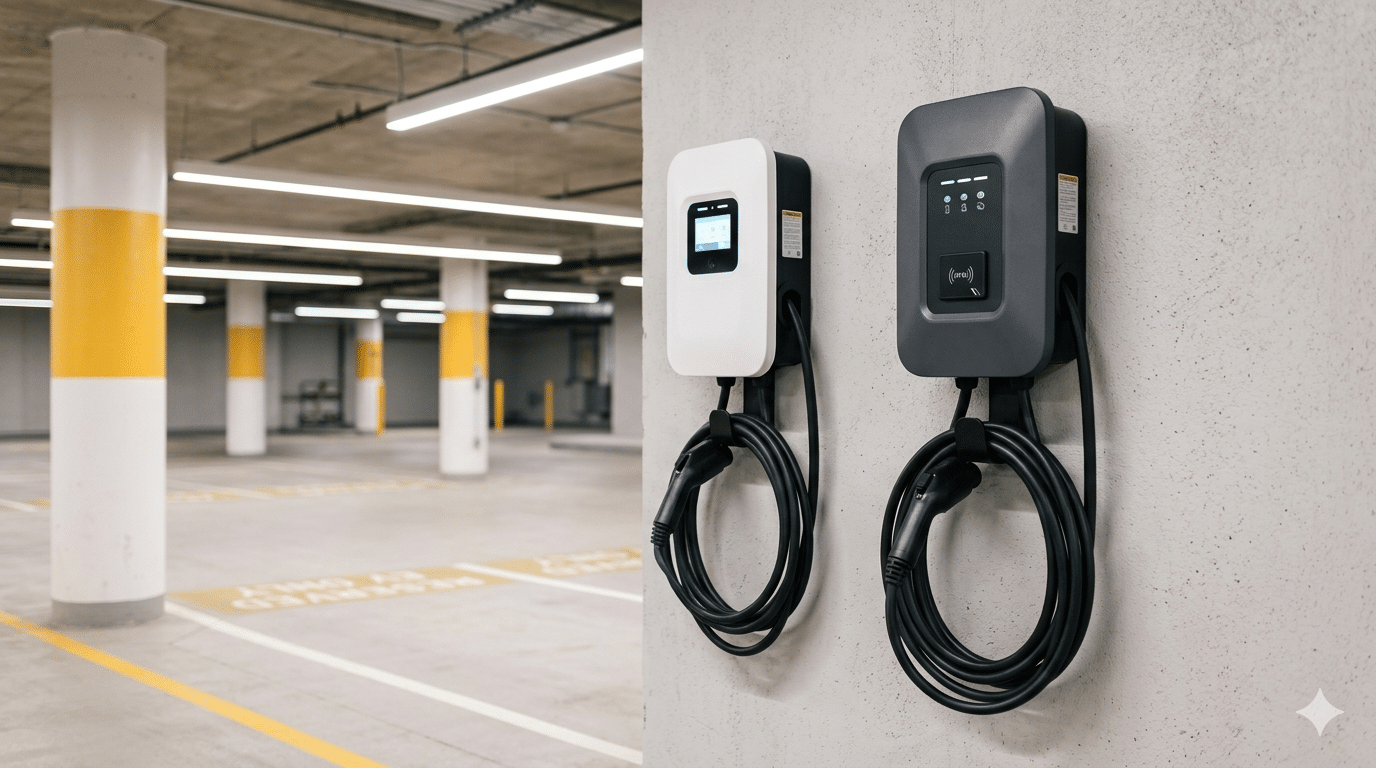
If you’ve had clients ask what to do with their inoperable JuiceBox commercial stations, you already know the context: Enel X Way North America shut down on October 11, 2024, with nine days’ notice. Commercial JuiceBox stations went dark — no network, no load management, no support. The backup plans (SWTCH, Noodoe, Ampcontrol) offer only partial migration because JuiceBox was never fully OCPP-compliant.
This ChargePoint vs Enel X guide examines your two serious options for commercial EV charger installations going forward: ChargePoint and ABB. We compare both from an installer’s perspective — hardware specs, certification requirements, software ecosystems, and 3-year total cost of ownership — so you have a clear recommendation ready when clients ask.
Contents
- 1 What the Enel X Shutdown Means for Your Business
- 2 ChargePoint vs Enel X: Comparing the Top Commercial EV Charging Networks
- 3 ABB E-mobility: Global Scale, OCPP-Open, High-Power DC
- 4 Use Case Comparison: Which Brand Fits Which Site
- 5 Installer Certification and Business Requirements
- 6 OCPP vs. Proprietary: The Platform Decision
- 7 Total Cost of Ownership: 3-Year Comparison
- 8 Which Brand Should You Recommend?
- 9 Frequently Asked Questions
- 9.1 In a ChargePoint vs Enel X comparison, is ChargePoint the best commercial EV charger in 2025?
- 9.2 What happened to Enel X JuiceBox commercial chargers?
- 9.3 Do I need special certification to install ChargePoint commercial stations?
- 9.4 What does OCPP mean for EV charger installations?
- 9.5 How much does a commercial EV charging installation cost?
- 9.6 What is the ChargePoint network fee for commercial charging stations?
- 10 Next Steps
What the Enel X Shutdown Means for Your Business
The JuiceBox story is the most important context for any EV charger brand recommendation you make in 2025. Enel X’s Italian parent company exited North America on short notice, and because JuiceBox operated as a closed, proprietary system, clients couldn’t simply migrate to another software platform. For most commercial sites, full hardware replacement is the only viable path.
Contractors who built their business around JuiceBox now have clients with inoperable commercial hardware and no software lifeline. The lesson isn’t that smaller vendors are always risky — it’s that closed, proprietary systems create stranded asset risk that open-protocol hardware avoids. This is the conversation to have with any client evaluating a platform today.
If you have existing JuiceBox commercial clients, evaluate migration options first. SWTCH and Noodoe offer partial pathways, but expect to lose load balancing and scheduling in most cases. For clients whose sites are already impacted, the question is whether a partial migration buys enough time to justify the cost, or whether full hardware replacement makes more economic sense now.
For new installations, the ChargePoint vs Enel X (ABB) comparison shows differences that run deeper than specs alone.
ChargePoint vs Enel X: Comparing the Top Commercial EV Charging Networks
ChargePoint is the largest AC Level 2 charging network in North America by a significant margin. According to Alternative Fuels Data Center data (2025), ChargePoint holds roughly 61% of the US public Level 2 market share. Over 1.3 million public and private ports run on the ChargePoint platform, and total network sessions grew 34% year-over-year through early 2026 (BusinessWire, February 2026).
The commercial hardware lineup covers most scenarios: the CPF50 for fleet depot and multifamily (up to 50A/12kW, $699–$899 depending on retailer), the CT4000 for destination and workplace charging (dual-port, up to 7.2kW per port), and the CP6000 for fleet applications with adjustable output from 3.7–22kW per port. DC fast charging is available through the Express series, reaching 62.5–125kW.
ChargePoint’s network software is purpose-built and mature — real-time load balancing, demand-response integration, utility pricing signal support, fleet reporting, and remote diagnostics. For operators who want a fully integrated system with minimal IT involvement, it’s the strongest platform in North America.
The tradeoff: ChargePoint hardware connects exclusively to ChargePoint’s cloud. Network software fees for the CT4000 and CP6000 run $475 per port per year (confirmed via ChargePoint’s commercial subscription SKU). The CPF50 is eligible for ChargePoint’s Essential plan, which skips the subscription fee in exchange for 10% of driver session payments — a better model for lower-utilization sites.
All ChargePoint commercial stations must be installed and commissioned by a ChargePoint-certified technician. More on that in the certification section below.
ABB E-mobility: Global Scale, OCPP-Open, High-Power DC
ABB E-mobility operates at a scale that most people don’t associate with EV charging: more than 1 million chargers sold across 85+ markets, including over 50,000 DC fast chargers. By September 2025, ABB and Alpitronic were the two largest deployed DC charging networks globally, each having delivered over 4.5 TWh of energy (etechvolution.com, September 2025).
For commercial Level 2 in North America, the Terra AC Wallbox is the primary product — available in 40A and 80A configurations (up to 19.2kW at 240V), with built-in overcurrent and surge protection, Ethernet daisy-chaining for multi-unit deployments, and Wi-Fi/Bluetooth/4G connectivity. It carries ENERGY STAR certification and supports both RFID and app-based authentication. Pricing varies by configuration and distributor — get a direct quote from an ABB-authorized distributor for current commercial pricing.
For sites that need more than Level 2 can deliver, the Terra DC Wallbox provides 22.5–24kW DC fast charging in a compact form factor — well-suited for fleet depots or workplaces with fast turnaround requirements but limited available power. The full Terra HP series scales to 350kW for high-throughput applications.
ABB’s defining characteristic is open-platform architecture. Terra hardware runs on OCPP 1.6J, meaning it can communicate with any OCPP-compliant software platform — not just ABB’s own. Site operators can choose their billing provider, switch platforms without replacing hardware, and integrate EV charging with existing building energy management systems through standard protocols.
This is the specific characteristic that makes ABB the relevant alternative post-Enel X: OCPP-compliant hardware doesn’t die when a vendor exits the market.
For a detailed breakdown of what Level 2 and DC fast charging mean for different commercial site types, see our guide to Level 2 vs. DC fast charging for commercial properties.
Use Case Comparison: Which Brand Fits Which Site
Retail and destination charging: ChargePoint wins here. The CT4000 family has the highest driver recognition, the largest network footprint for public payment, and the clearest brand signal for property marketing. If a retail client wants to attract EV drivers who are already using the ChargePoint app, this is the easiest recommendation.
Workplace Level 2 (single employer, managed access): Either brand works well. ChargePoint offers a more integrated employee management and billing experience. ABB offers OCPP flexibility that allows the employer to choose or change their software platform independently. The deciding factor is usually whether the facilities team wants a single-vendor relationship (ChargePoint) or platform flexibility (ABB).
Multifamily with power constraints: ABB’s OCPP support gives more options for dynamic load management across a mixed hardware environment. For a 30-unit building managing a constrained panel, the ability to choose third-party load management software — and potentially mix hardware brands over time — is a material advantage. ChargePoint supports load sharing within their own hardware ecosystem, but ties the operator to their platform.
Fleet depot and DC fast charging: ABB’s Terra DC Wallbox is built for sites that need faster turnaround than Level 2 allows but don’t have the electrical infrastructure for 50kW+ units. ChargePoint’s Express series reaches higher power levels (62.5–125kW) but operates exclusively on their proprietary platform. For fleet clients who want OCPP interoperability with telematics or fleet management software, ABB is the clearer choice.
This is the kind of site-specific analysis a qualified installer walks through during a formal assessment. Search for certified EV charging installers in your area to get one scheduled for your next project.
Installer Certification and Business Requirements
This is the section that matters most for how you structure your EV charging business — and it’s the section no other comparison article covers.
ChargePoint Installer Requirements
ChargePoint requires brand-specific technician certification before any commercial station can be installed or commissioned. The exam takes approximately 90 minutes and covers EVSE fundamentals and ChargePoint product specifics. The exam itself is free — but it’s only recognized once your business has been approved as a ChargePoint O&M (operations and maintenance) partner.
Partner approval requires meeting ChargePoint’s standards for financial stability, service coverage area, and technical capacity. Once approved, you gain access to the ChargePoint installer portal, co-marketing materials, and — depending on your partner tier — inbound lead referrals from ChargePoint’s sales team. For contractors in markets where ChargePoint is actively deploying, that pipeline can be meaningful.
The certification requirement effectively acts as a barrier to entry for competitors. Fewer certified installers in your area means less price pressure on your labor. That’s a tangible business benefit of the ChargePoint partnership model.
ABB Installation Requirements
ABB has no proprietary certification requirement for Terra hardware installation. Standard electrical licensing and local AHJ compliance govern the work. ABB offers product-specific training through their E-mobility portal — completing it is recommended for full warranty coverage and to handle commissioning correctly, but it doesn’t gate your ability to install or activate stations.
The tradeoff: without a certification channel, there’s more competitive pressure on your pricing from other installers. ABB doesn’t control the installer channel the way ChargePoint does.
For EVITP certification — which some utilities and municipalities now require as a condition of incentive programs — see our overview of EVITP certification and what it means for EV charging projects.
OCPP vs. Proprietary: The Platform Decision
In any ChargePoint vs Enel X (ABB) comparison, for commercial installations with more than a few ports, the software platform decision matters as much as the hardware choice. Here’s what the two approaches actually mean on a job site.
ChargePoint’s proprietary ecosystem means that ChargePoint hardware communicates exclusively with ChargePoint’s cloud. Operators pay network fees ($475/port/year for CT4000 and CP6000), receive billing, reporting, and load management through ChargePoint’s platform, and have limited options if they want to change software providers without replacing hardware. The platform is genuinely strong — ChargePoint’s load balancing, demand-response integration, and fleet reporting are the most mature in North America. But the lock-in is real, and operators experienced with the Enel X situation are asking about it explicitly.
ABB’s OCPP support means Terra hardware can connect to any OCPP-compliant platform — SWTCH, Monta, Driivz, Ampcontrol, and dozens of others. An operator who wants to switch billing providers in year three can do so without replacing hardware. A fleet manager who needs EV charging integrated with existing energy management software can route through standard OCPP channels. OCPP 2.0.1 was ratified as an IEC standard (IEC 63584) in 2024; OCPP 2.1 was released in 2025 — the protocol is stable and widely adopted.
For multi-port installations with power constraints, OCPP-based dynamic load distribution also allows mixing hardware from multiple manufacturers on the same circuit — something ChargePoint’s ecosystem doesn’t support across different hardware brands. On dense multifamily sites where phased installation is common, this is a practical advantage.
The JuiceBox shutdown is the starkest real-world example of closed-system risk. OCPP compliance doesn’t guarantee a vendor stays in business — but it does mean your client’s hardware survives if they need to switch platforms. That’s the argument to make when a client is weighing the two.
Reviewing our EV charging contractor checklist before starting any commercial assessment helps ensure you’re covering the software and load management questions alongside the electrical ones.
Total Cost of Ownership: 3-Year Comparison
Commercial EV charging decisions that look similar on hardware price often look very different over three years when you factor in network fees, warranty, and migration risk. Installed commercial Level 2 ports run $7,000–$15,000 per port, depending on site conditions (Qmerit, 2025); DC fast charger installations range from $50,000 to $200,000+ per unit based on power level, trenching, and utility upgrade requirements.
| Cost Factor | ChargePoint CPF50 | ChargePoint CT4000/CP6000 | ABB Terra AC |
|---|---|---|---|
| Hardware (per unit) | $699–$899 | Contact ChargePoint | Contact an ABB distributor |
| Network software (annual) | 10% of session fees (Essential plan) | $475/port/year | Operator’s choice; OCPP SaaS varies |
| 3-year software cost | Variable (usage-based) | $1,425/port | ~$150–$600/port (third-party OCPP) |
| Migration risk | High — proprietary hardware and software | Low — hardware survives platform change | |
| Installer certification | Required (free, ~90 min + partner approval) | Not required; training recommended | |
The CT4000/CP6000 network fee of $475/port/year adds up on larger installations — a 20-port workplace deployment carries a $9,500/year software cost on top of hardware and installation. For clients doing the math on long-term operating costs, that figure matters. For low-utilization sites using the CPF50 Essential plan, the usage-based model can be more favorable.
ABB’s TCO advantage is strongest where platform flexibility has real value — fleet depots, multifamily buildings with phased deployment plans, and any client who has specifically flagged platform lock-in as a concern after watching JuiceBox customers lose their hardware investment.
State and federal incentives can offset both hardware and installation costs significantly. See our breakdown of EV charging incentives by state for current funding options your clients can apply toward these projects.
For accurate per-port numbers on a specific site, installation variables swing costs by $3,000–$8,000 per port. Request a quote to get numbers tied to your actual site conditions.
Which Brand Should You Recommend?
Recommend ChargePoint when: The client is a retail or destination operator who wants maximum driver visibility and the largest network footprint. The client prioritizes a fully integrated software platform and wants a single-vendor relationship for hardware and management. Your business has or is pursuing the ChargePoint O&M partner program, and the inbound lead referral pipeline matters to your growth plan.
Recommend ABB when: The client is a fleet operator or municipal agency that needs OCPP interoperability with existing systems. The site has power constraints requiring dynamic load management across a mixed hardware environment. The client is specifically concerned about platform lock-in — a common conversation post-Enel X — and wants hardware that survives a platform change. The project involves DC fast charging in the 20–30kW range, where ABB’s Terra DC Wallbox is purpose-built.
For stranded JuiceBox commercial clients: Evaluate SWTCH or Noodoe migration first. If full hardware capability can’t be restored through migration, make the TCO case for replacement now rather than waiting for the next failure point. For clients who watched Enel X’s exit, ABB’s open architecture is a cleaner sell than returning to a proprietary system.
Every commercial project has site-specific variables that shift the recommendation. Find certified EV charging installers near you through the EVContractors.io directory to connect with professionals who can assess your site and spec the right solution.
Frequently Asked Questions
In a ChargePoint vs Enel X comparison, is ChargePoint the best commercial EV charger in 2025?
ChargePoint holds roughly 61% of US public Level 2 market share and remains the strongest choice for retail and destination charging where driver network visibility matters (Alternative Fuels Data Center, 2025). For fleet depots, multifamily buildings with power constraints, or any client prioritizing platform flexibility over ChargePoint’s network, ABB is the more practical choice.
What happened to Enel X JuiceBox commercial chargers?
Enel X Way North America shut down on October 11, 2024, leaving commercial JuiceBox stations fully inoperable. Because JuiceBox used a largely closed architecture, migration to alternative software platforms results in significant functionality loss — particularly load balancing and scheduling. Most commercial sites will need full hardware replacement.
Do I need special certification to install ChargePoint commercial stations?
Yes — ChargePoint requires brand-specific technician certification (a free ~90-minute exam) and business approval as a ChargePoint O&M partner before commercial stations can be installed and commissioned. ABB has no proprietary certification requirement; standard electrical licensing and AHJ compliance govern the work, though completing ABB’s product training is recommended for full warranty coverage.
What does OCPP mean for EV charger installations?
OCPP (Open Charge Point Protocol) allows EV charging hardware to communicate with multiple software platforms for billing, monitoring, and load management. ABB Terra hardware supports OCPP, so site operators can switch software providers without replacing equipment. ChargePoint hardware connects only to ChargePoint’s proprietary network — a closed ecosystem that makes platform changes expensive. The Enel X shutdown is the sharpest real-world example of what closed-system lock-in costs when a vendor exits.
How much does a commercial EV charging installation cost?
Commercial Level 2 installations run $7,000–$15,000 per port fully installed, covering hardware, labor, permitting, and electrical work (Qmerit, 2025). DC fast charger installations range from $50,000 to $200,000+ per unit, depending on power level, trenching, and utility upgrade scope. Brand choice typically represents 30–50% of total project cost — site conditions and electrical infrastructure drive the rest.
What is the ChargePoint network fee for commercial charging stations?
ChargePoint’s CT4000 and CP6000 commercial stations carry a $475 per port per year cloud services subscription fee. The CPF50 qualifies for ChargePoint’s Essential plan, which skips the subscription in exchange for 10% of driver session payments — better suited for lower-utilization sites where usage-based fees come out below the flat subscription cost.
Next Steps
This ChargePoint vs Enel X equipment comparison shows that the right brand for a commercial EV charging project depends on the site, the client’s operating model, and how they weigh platform flexibility against network visibility. Both ChargePoint and ABB are viable — the decision comes down to specifics.
Use the EVContractors.io installer directory to find certified EV charging contractors in your area, or submit your project for quotes and compare bids from vetted installers who know both platforms.
Specs, pricing, and market data are current as of March 2026. Verify current pricing directly with ChargePoint, ABB, and authorized distributors before finalizing project specs.