Contents
- 1 Why Apartment Owners Can’t Afford to Sit This One Out
- 2 How to Install EV Charging at an Apartment Complex
- 3 What Does It Cost to Add EV Charging to an Apartment Building?
- 4 Incentives for EV Charging in Apartment Buildings
- 5 Who Pays for EV Charging in Apartments?
- 6 Choosing the Right Charger for Your Apartment Building
- 7 Finding the Right Installer for a Multifamily Project
- 8 Frequently Asked Questions
- 8.1 How do I install EV charging at an apartment complex?
- 8.2 Who pays for EV charging in an apartment building?
- 8.3 How much does it cost to add EV charging to a multifamily property?
- 8.4 Are there incentives for EV charging in apartment buildings?
- 8.5 What is the best EV charger for an apartment building?
- 8.6 Can I install EV chargers without upgrading my electrical panel?
- 9 Get Started Before the Incentive Window Closes
Why Apartment Owners Can’t Afford to Sit This One Out
About 31% of Americans live in multifamily housing, and the vast majority of those residents have no way to charge an EV where they live. A 2024 SWTCH Energy survey of over 1,500 apartment and condo residents found that 82% of non-EV drivers reported zero charging options at their building — and 67% said access to on-site charging would push them to seriously consider switching to an EV.
If you own or manage an apartment complex, you’ve probably started fielding these requests at lease renewal. Maybe you’ve noticed newer competing properties advertising EV charging as a standard amenity. The pressure is real, and it’s coming from the market — not just from individual tenants.
MRI Software’s Voice of the Resident Report found that roughly two-thirds of U.S. renters consider green building practices important when choosing where to live, with 40% saying they’d refuse to rent at a property that lacks them. EV charging is increasingly part of that calculation.
The math is straightforward: properties with EV charging attract stronger lease renewals and justify premium rents. New construction in most major markets is wiring EV-ready infrastructure during framing — and retrofitting that same work later costs 5–10x more. Every month you wait, the cost of catching up goes up.
Before you start budgeting, it helps to understand the full cost picture for commercial EV charging installations — multifamily projects share many of the same cost drivers.
How to Install EV Charging at an Apartment Complex
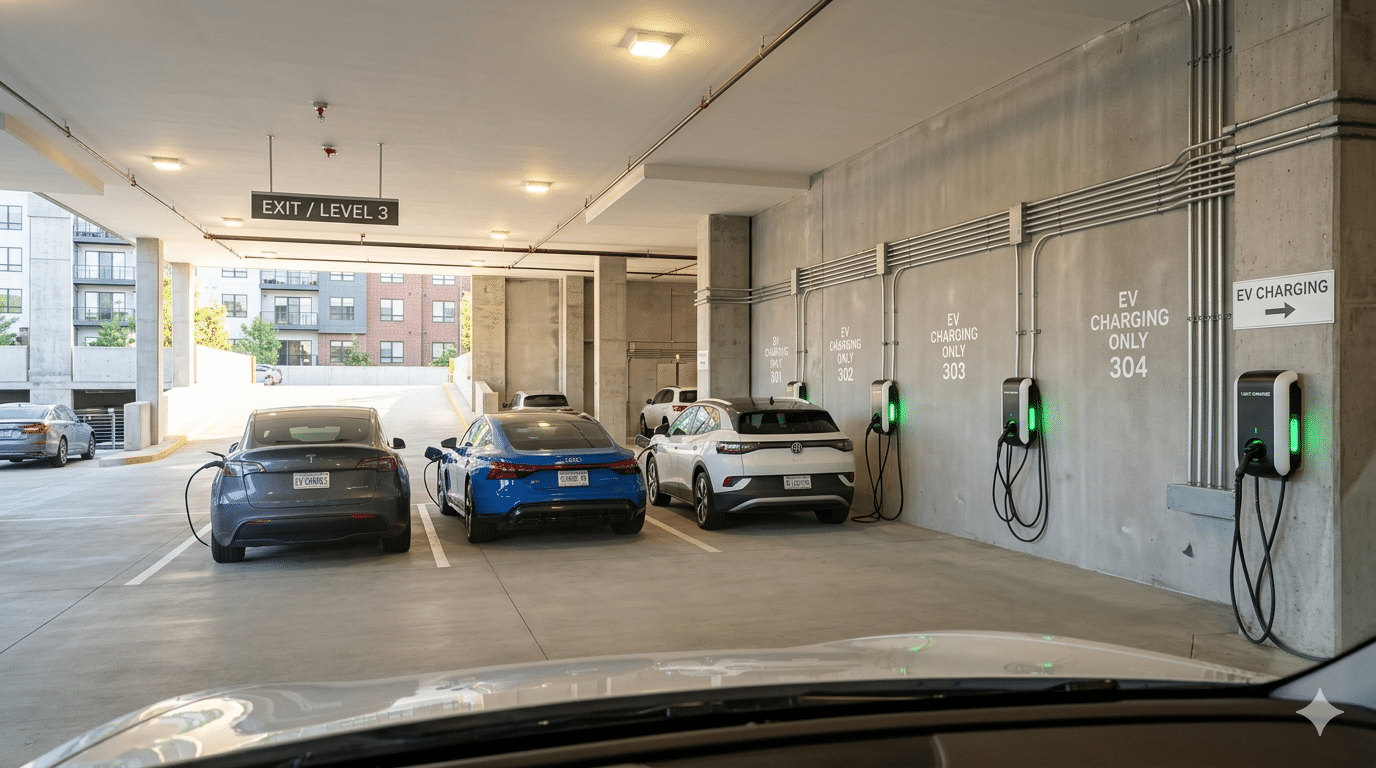
Installing EV charging at a multifamily property is a commercial electrical project. It requires permits, utility coordination, load analysis, and often significant panel or service entrance work. Here’s how it typically unfolds.
Step 1: Site Assessment
A qualified contractor evaluates your existing electrical infrastructure — panel capacity, transformer ratings, available conduit pathways, and parking layout. This determines what’s feasible without major utility upgrades and informs your charger count and placement strategy. Don’t skip this step or try to spec it yourself; the electrical realities of older apartment buildings routinely surprise owners who assumed their panels could handle the load.
Step 2: Select Charger Type and Quantity
For most apartment complexes, Level 2 chargers (240V AC) are the right fit. They deliver 20–45 miles of range per hour of charging, which easily covers overnight dwell times. DC fast chargers cost dramatically more — both the hardware and the electrical infrastructure to support them — and the use case doesn’t match residential parking where cars sit for 8–12 hours. For a deeper comparison of these two options, see our breakdown of Level 2 vs. DC fast charging for commercial properties.
Shared charging stations in common areas work well for smaller properties or when budget is the primary constraint. Assigned charging — a dedicated port per unit or parking space — is the premium option that commands higher rents and eliminates disputes over charger availability. Most larger properties land on a hybrid approach: shared stations in visitor areas, assigned ports for select parking spots.
Step 4: Pick a Billing Model
This is where many property owners stall. Your main options:
- Pass-through billing: Tenants pay the electricity cost directly through a managed charging platform. Most transparent for tenants and simplest for dispute resolution.
- Flat monthly fee: Bundled into rent or as a separate line item. Easier to administer, but requires careful modeling so you’re not subsidizing heavy users.
- Per-kWh or per-session billing: Requires a networked charger with metering capability. Fairest per-tenant cost allocation, but adds platform management.
- Third-party ownership: A company like EverCharge, SWTCH, or ChargePoint installs and operates the equipment at no upfront cost to you. You provide parking and electrical access; they handle the rest. You may receive a revenue share or simply gain the amenity value.
A reasonable starting point for pass-through pricing is the cost of electricity plus roughly $0.25/hour as a recovery surcharge, though the right number depends on your local electricity rates and how quickly you want to recoup infrastructure costs.
Step 5: Permit, Install, Commission
Your contractor handles permit applications, coordinates with the utility on any service upgrades, and manages the physical installation. Commissioning includes testing each port, connecting networked chargers to their management platform, and confirming that load management is distributing power correctly. Plan for 2–4 months from the signed contract to the first active charging port.
What Does It Cost to Add EV Charging to an Apartment Building?
Costs vary widely based on your starting electrical capacity, parking configuration, and charger count. Industry data for 2026 puts Level 2 installations at roughly $3,000–$15,000 per port fully installed, depending on the scope of electrical work required. A 10-port Level 2 installation at a typical apartment complex runs $40,000–$120,000 all-in.
The single biggest variable in multifamily installations is existing electrical capacity. Older buildings with limited panel amperage often need service entrance upgrades or transformer work to support multiple simultaneous chargers. A load management system — which dynamically distributes available power across ports — is almost always the smarter investment. It lets you install more chargers on your existing electrical service without paying for a full transformer or panel upgrade.
New construction is a different equation entirely. Installing EV-ready conduit and stub-outs during framing typically costs $500–$2,000 per parking space — a small fraction of what retrofitting the same infrastructure costs once the building is occupied.
Costs vary significantly by property type and local utility rates. Request a quote to get numbers specific to your building and location.
Typical Scenarios by Property Type
- Small complex (10–30 units), 4–6 shared chargers: $15,000–$50,000 depending on panel capacity and trenching requirements. Shared stations in a central parking area keep costs low.
- Mid-size complex (50–100 units), 10–20 ports with load management: $50,000–$150,000. Load management keeps infrastructure costs in check while maximizing charger count.
- Large complex (100+ units), phased rollout with assigned and shared charging: $100,000–$300,000+ for initial phase. Most large properties are installed in phases — starting with 10–15% coverage and expanding as demand grows.
Incentives for EV Charging in Apartment Buildings
This is where apartment owners routinely leave significant money on the table — especially those who don’t work with a contractor who understands the incentive landscape.
Federal 30C Tax Credit
The Section 30C Alternative Fuel Vehicle Refueling Property Credit is the most significant federal incentive available right now. For commercial properties in eligible census tracts, it covers 30% of eligible project costs — up to $100,000 per charging port — when prevailing wage and apprenticeship requirements are met. Properties that don’t meet prevailing wage requirements can still claim the base credit at 6%.
Critical deadline: Under the One Big Beautiful Bill Act signed in July 2025, the 30C credit expires for equipment placed in service after June 30, 2026. The original expiration was December 31, 2032 — this deadline was moved up by more than six years. If your project isn’t permitted and installed before that cutoff, you miss this window entirely.
To qualify for the full 30% credit, your property must be located in an eligible census tract (low-income or non-urban as defined by the IRS). You can check eligibility using the Census Bureau’s 2020 Census Tract Identifier and cross-referencing the IRS’s Appendix B tract list. The credit is claimed via IRS Form 8911.
State and Utility Programs
Most states with active EV adoption programs offer additional rebates, grants, or low-interest financing for multifamily EV charging. California, New York, Colorado, Massachusetts, and Washington are among the most active. Massachusetts, for example, offers utility-funded programs through Eversource and National Grid that can cover up to 100% of infrastructure costs for qualifying multifamily properties.
Many utilities also offer make-ready infrastructure programs that cover trenching and panel upgrade costs. The right contractor knows which programs apply to your location and can help you stack incentives — federal credit on top of a state rebate on top of a utility make-ready program. That combination can reduce your net project cost by 40–60%.
This is exactly the kind of assessment a qualified installer handles during project planning — search for installers in your area to find contractors experienced with multifamily incentive programs.
Who Pays for EV Charging in Apartments?
This is one of the most common questions from apartment owners, and the answer depends entirely on the billing model and your lease structure.
In a pass-through model, tenants pay for the electricity they consume directly through the charger’s network platform. The property covers the infrastructure cost (charger + installation) and may recover that through a monthly access fee or a slight premium on parking rates. This is the most transparent model and the one most tenants prefer because they only pay for what they use.
In a flat-fee model, the electricity cost is bundled into rent or a fixed monthly parking charge. This is simpler to administer but requires careful modeling to avoid subsidizing heavy EV users at the expense of non-EV tenants. If 5% of your residents are driving EVs and consuming electricity paid for by the other 95%, you’ll hear about it.
Third-party ownership removes the capital question entirely. A charging network company installs and operates the equipment on your property. You provide the parking spaces and electrical access; they handle everything else. You may receive a revenue share, an amenity fee, or simply the benefit of charging infrastructure as a tenant retention tool. This model is particularly attractive for owners who want the amenity but don’t want to manage a charging operation.
For larger properties, a hybrid is common: assigned charging with direct billing for dedicated EV tenants, shared visitor charging at flat or metered rates for occasional users.
Choosing the Right Charger for Your Apartment Building
For multifamily residential use, Level 2 networked chargers in the 6.2–7.7kW range are the standard choice. Here’s what matters when selecting hardware:
- ENERGY STAR certification: Required by many utility rebate programs and a signal of energy efficiency.
- OCPP 2.0.1 compatibility: The current open interoperability standard. This ensures your chargers aren’t locked to a single software vendor and can work with whichever management platform you choose — or switch to later.
- Load management capability: Either built-in or compatible with a property-wide load management system. This is non-negotiable for any multifamily installation with more than a handful of chargers.
- Outdoor-rated enclosure: NEMA 3R or 4X rating for exposed parking locations.
- Access control: RFID card, app-based, or auto-start, depending on whether spaces are assigned or shared.
- Network connectivity: Cellular is more reliable than Wi-Fi for parking garages and outdoor lots where signal strength is inconsistent.
Established hardware manufacturers with strong commercial support include ChargePoint, Blink, Eaton, Siemens, and Leviton. Your installer should be familiar with multiple platforms and give you a recommendation based on your property’s specific needs — not based on which manufacturer offers them the best referral fee.
Finding the Right Installer for a Multifamily Project
Multifamily EV charging installations are not standard commercial electrical jobs. They demand experience with load management in high-density parking settings, familiarity with utility interconnection processes, and ideally a track record on apartment or condo properties specifically. The wrong contractor can create problems that are expensive to fix — oversized panels that fail utility interconnection, improperly rated conduit for outdoor applications, or ADA non-compliance that fails inspection.
What to look for in a multifamily EV charging contractor:
- EVITP certification: The Electric Vehicle Infrastructure Training Program certification is required for NEVI-funded projects and is a strong quality signal for any commercial installation. Learn more about NEVI program requirements and how EVITP fits in.
- Licensed, bonded, and insured in your state — verify this independently, don’t take their word for it.
- Demonstrated multifamily experience: Ask specifically about apartment and condo projects, not just “commercial” work. A contractor who installs chargers at corporate offices may not understand the electrical constraints of a 1970s apartment building.
- Incentive program knowledge: They should know which federal, state, and utility programs apply to your location without you having to explain them.
- References from similar projects: Ask for them and actually call them.
- Maintenance capability: Chargers need ongoing service. A contractor who can only install but not maintain creates a future headache.
Get 3–5 bids for any project of this size. Bids that come in dramatically below the field often signal that the contractor has underestimated the electrical scope — and that becomes your problem at change order time.
Find multifamily-experienced EV charging installers in your area, or submit your apartment complex project details for contractor matching.
Frequently Asked Questions
How do I install EV charging at an apartment complex?
Start with a site assessment from a qualified commercial EV charging contractor who will evaluate your electrical capacity, parking layout, and target charger count. From there, the process covers permitting, utility coordination, installation, and commissioning — typically a 2–4 month timeline from contract to operational chargers.
Who pays for EV charging in an apartment building?
It depends on your billing model. Common approaches include pass-through billing, where tenants pay per kWh through a charging app, flat monthly fees bundled into rent or parking, or third-party ownership, where a network operator installs and manages equipment at no upfront cost to you. Each model has different trade-offs around administrative effort and cost recovery speed.
How much does it cost to add EV charging to a multifamily property?
A 10-port Level 2 installation typically runs $40,000–$120,000 all-in, depending on existing panel capacity, parking configuration, and whether trenching or service upgrades are needed. Load management systems can significantly reduce costs by allowing more chargers on your existing electrical service without a panel or transformer upgrade.
Are there incentives for EV charging in apartment buildings?
Yes. The federal Section 30C tax credit covers up to 30% of eligible costs (capped at $100,000 per port) for commercial properties in qualifying census tracts — but equipment must be placed in service by June 30, 2026. Most states with active EV programs offer additional rebates, and many utilities fund make-ready infrastructure programs. A knowledgeable contractor can help you stack these incentives to reduce net project cost by 40–60%.
What is the best EV charger for an apartment building?
For most multifamily properties, Level 2 networked chargers in the 6.2–7.7kW range are the right fit. Prioritize ENERGY STAR certification, OCPP 2.0.1 compatibility, load management capability, and outdoor-rated enclosures (NEMA 3R or 4X). The best specific charger for your property depends on your parking layout, tenant mix, and utility requirements — a qualified installer should give you a neutral recommendation.
Can I install EV chargers without upgrading my electrical panel?
Often, yes — with a load management system. These systems dynamically distribute available power across multiple charging ports, letting you install significantly more chargers than your panel would otherwise support. One real-world multifamily example expanded from 10 to 40 charging ports on existing electrical service using intelligent load management, with no panel upgrade required.
Get Started Before the Incentive Window Closes
EV charging is moving from an optional amenity to an expected infrastructure at apartment properties. The federal 30C tax credit — worth up to 30% of your project cost — expires June 30, 2026, and that deadline isn’t getting extended. The best time to add charging was when your building was constructed. The second-best time is now, while significant incentive dollars are still available.
EVContractors.io connects apartment owners and property managers with commercial EV charging installers who have real multifamily experience. Search by location, filter by certification, and request a quote — all without going through a hardware manufacturer’s sales team.