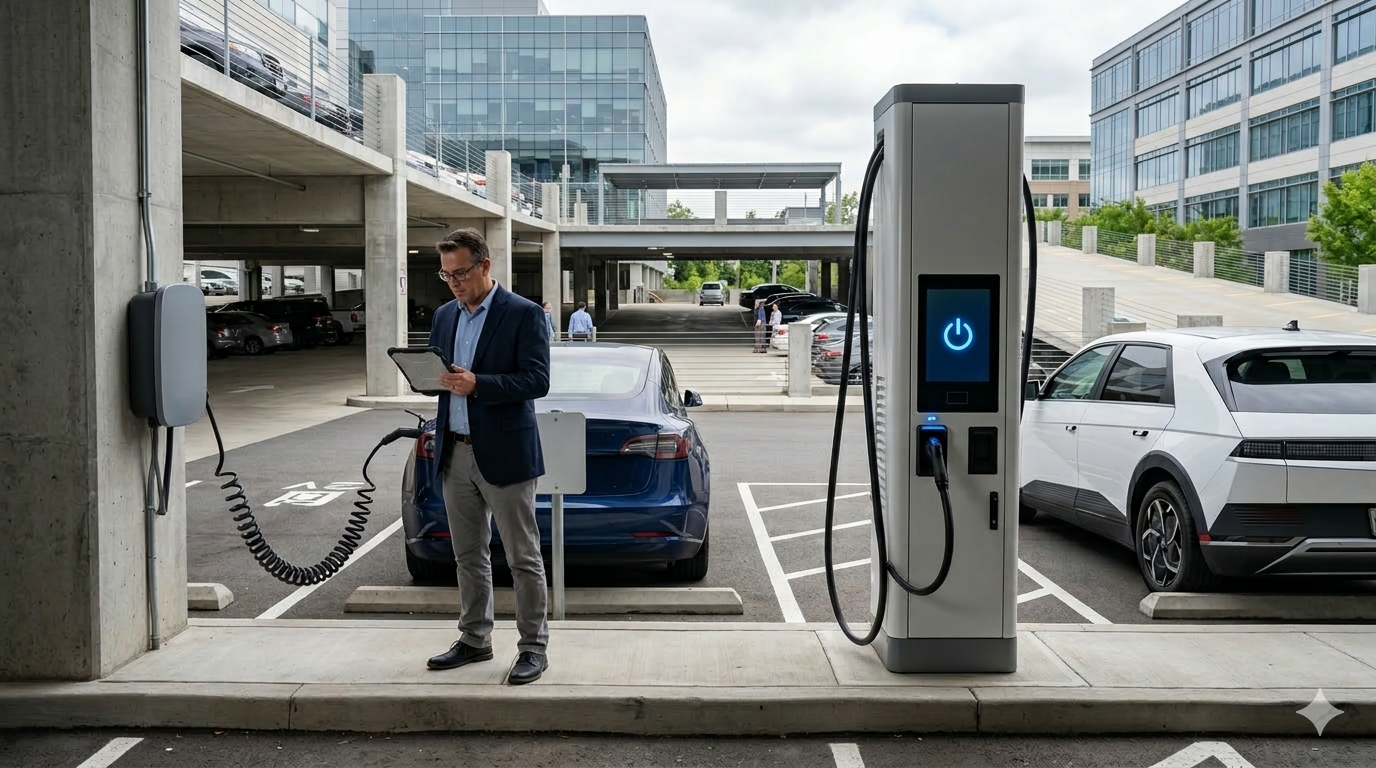
A single DC fast charger can cost more than 20 Level 2 ports combined. Pick the wrong type for your building, and you either blow your budget on speed nobody needs — or install chargers too slow for the traffic you actually get.
This guide breaks down level 2 vs DC fast charging commercial properties: what each costs to install, how charging speed maps to parking behavior, and which setup makes financial sense for offices, retail centers, multifamily buildings, and fleet depots.
Contents
- 1 How Level 2 and DC Fast Charging Work Differently
- 2 Level 2 vs DC Fast Charging Commercial: Which Fits Your Property?
- 3 Why Dwell Time Is the Variable That Matters Most
- 4 What Level 2 vs DCFC Actually Costs to Install
- 5 Can You Mix Level 2 and DCFC at One Location?
- 6 A Decision Framework for Facility Directors and Property Managers
- 7 Find a Contractor Who Understands Commercial EV Charging
- 8 Frequently Asked Questions
- 8.1 What is the difference between Level 2 and DC fast charging?
- 8.2 Which type of EV charger is best for commercial properties?
- 8.3 How much does Level 2 vs DC fast charging cost to install?
- 8.4 What is dwell time and why does it matter for EV charger selection?
- 8.5 Can you install both Level 2 and DC fast chargers at the same property?
- 8.6 What federal incentives are available for commercial EV charger installation?
How Level 2 and DC Fast Charging Work Differently
The core difference is where the power conversion happens — and that one detail drives everything else: speed, cost, and electrical requirements.
Level 2 Charging (AC Power)
Level 2 chargers deliver 240-volt AC power to the vehicle. Every EV has a built-in converter that transforms this AC into the DC current the battery stores. Output typically ranges from 7 kW to 19.2 kW, which translates to roughly 20 to 60 miles of added range per hour depending on the charger’s output and the vehicle’s onboard converter capacity.
For commercial properties, Level 2 is the workhorse. Installed costs run $3,000 to $15,000 per port including equipment and electrical work — though most projects land in the $3,000 to $12,000 range unless significant panel upgrades or long trenching runs are involved.
DC Fast Charging (DCFC)
DC fast chargers skip the vehicle’s onboard converter entirely and push high-voltage DC straight to the battery. A modern DCFC can add 100 to 200+ miles of range per hour, with many EVs reaching 80% charge in 15 to 20 minutes.
That speed requires serious electrical infrastructure. DCFC units need 480-volt (or higher) service, often requiring transformer upgrades, and installed costs range from $70,000 to over $250,000 per port once you factor in equipment, electrical service upgrades, site work, and permitting. Some complex installations push past $350,000.
Level 2 vs DC Fast Charging Commercial: Which Fits Your Property?
The answer depends almost entirely on two things: how long vehicles park at your location, and what your electrical service can handle without major upgrades.
Office Buildings and Corporate Campuses
Level 2 is the clear fit here. Employees park for six to nine hours — far more time than even a modest Level 2 charger needs to deliver a full charge. The lower per-port cost means you can deploy 10, 20, or 40 ports and serve a meaningful percentage of your parking without triggering major utility demand charges. DCFC at an office building is almost always overbuilding for the use case.
Retail Centers and Shopping Destinations
Retail is where the decision gets more interesting. Industry data presented at an EVCS industry panel found that EV drivers at retail locations spend approximately 50 additional minutes shopping while their vehicle charges — translating to roughly $1 per minute in incremental spending. At one session per day, that works out to about $18,000 in additional on-site spending per charger annually.
For most retail centers, a hybrid approach works best: Level 2 chargers in general parking for shoppers who browse for an hour or more, and a small number of DC fast chargers near the entrance for drivers who want a quick stop. This covers both use cases without overinvesting in expensive DCFC infrastructure across the entire lot.
Fleet Depots and Distribution Facilities
Fleet charging depends on your operational cycle. If vehicles return overnight and sit for eight to twelve hours, Level 2 is typically sufficient and far cheaper to deploy at scale. If you run short-turnaround routes — vehicles back for two to four hours between dispatches — DCFC may be necessary to guarantee full range before the next run.
Load management is a critical consideration for fleets. Thirty Level 2 chargers on a smart charging system can often operate within existing electrical service capacity. Add ten DC fast chargers to the same depot, and you may be looking at a six-figure transformer upgrade before you charge a single vehicle.
Multifamily and Mixed-Use Properties
Apartment complexes are almost exclusively Level 2 territory. Residents park overnight — exactly the scenario Level 2 is built for. Installing DCFC at a residential property rarely makes financial sense: the speed advantage is irrelevant when a vehicle has eight hours to charge, and the per-port cost difference is enormous.
Why Dwell Time Is the Variable That Matters Most
Dwell time — how long a vehicle stays parked at your location during a typical visit — is the single most important factor in choosing between Level 2 and DCFC. It’s also the one most often ignored in favor of raw speed comparisons.
A Level 2 charger adds roughly 25 miles of range in 30 minutes. If your average parking session runs 90 minutes — a movie theater, a grocery-anchored shopping center, a medical office — Level 2 delivers meaningful charge that drivers genuinely value. DCFC would be wasted capacity.
But at a highway rest stop or quick-service location where drivers park for 15 to 20 minutes, Level 2 barely registers. That’s where DCFC earns its premium — drivers actively seek out fast charging locations during road trips, and that traffic has measurable commercial value.
What Level 2 vs DCFC Actually Costs to Install
Installation cost is where the two technologies diverge most sharply, and understanding what drives the numbers on each side will help you set a realistic budget before you request contractor quotes.
Level 2 Cost Breakdown
Equipment: $600 to $6,500 per unit for commercial-grade, networked chargers. Wall-mounted units cost less than pedestal models, and smart features (load management, app connectivity, payment processing) push the price higher.
Electrical panel work: $2,000 to $8,000 depending on existing capacity and how many circuits you’re adding.
Trenching and conduit: $500 to $3,000 per port, depending on the distance from the electrical panel to the parking area.
Permitting: $100 to $1,500 per project depending on your jurisdiction.
Total installed cost: $3,000 to $15,000 per port, with most commercial projects falling in the $3,000 to $12,000 range.
DCFC Cost Breakdown
Equipment: $25,000 to $100,000+ per unit for standard 50–150 kW chargers. High-power units (150–350 kW) run $100,000 to $200,000+.
480V+ electrical service: Upgrading to the voltage DCFC requires often costs $20,000 to $80,000 or more.
Transformer upgrades: If your local utility needs to install or upgrade a transformer, expect $50,000 to $150,000+ in some markets.
Permitting and engineering: $5,000 to $20,000 for commercial DCFC installations.
Total installed cost: $70,000 to $250,000+ per port, with complex or high-power installations sometimes exceeding $350,000.
The Demand Charge Factor
Beyond installation, ongoing electricity costs diverge significantly. Level 2 chargers place less strain on the electrical grid and generally avoid triggering utility demand charges. DCFC installations can generate substantial monthly demand charges — in some utility territories, these recurring costs can rival the installation expense within a few years. If your utility applies peak demand pricing, model the operational costs carefully before committing to DCFC.
For a detailed walkthrough of what drives commercial EV charging project budgets, see our complete guide to commercial EV charging installation costs.
Can You Mix Level 2 and DCFC at One Location?
Yes — and for most mid-to-large commercial properties, a hybrid deployment is the strongest long-term strategy. The basic setup:
- Level 2 across the general parking field for all-day parkers, regular visitors, and employees
- DCFC at premium spots near the entrance for quick-stop and highway-adjacent traffic
- Network management software to balance electrical load across both charger types
Starting with Level 2 and adding DCFC later is a common phasing strategy that works well in practice. The electrical infrastructure you build for Level 2 doesn’t need to be redone — you’re expanding, not replacing. If you’re in early planning, ask your contractor to assess your site’s DCFC readiness now, even if you don’t plan to install fast chargers for two or three years. Running extra conduit and oversizing your panel during initial construction is far cheaper than retrofitting later.
A Decision Framework for Facility Directors and Property Managers
Before requesting your first contractor quote, work through these four questions:
1. What’s your average parking dwell time? Under 30 minutes pushes strongly toward DCFC. Over 90 minutes is almost always Level 2. The 30-to-90-minute range is where hybrid deployments tend to make the most sense.
2. What’s your existing electrical capacity? If you’re already near capacity, DCFC will require expensive utility work. Level 2 can often be deployed within existing service limits using smart load management, which dynamically distributes power across ports without overloading your panel.
3. What funding is available? The federal NEVI program covers up to 80% of eligible project costs — but applies specifically to DCFC installations along designated Alternative Fuel Corridors with specific technical requirements (minimum four 150 kW DC fast ports per station). The Section 30C federal tax credit covers up to 30% of installation costs for both Level 2 and DCFC (up to $100,000 per port for commercial projects meeting prevailing wage requirements), but only for installations in eligible census tracts and placed in service by June 30, 2026. State and utility incentive programs vary — check your state DOT and local utility for current offerings.
4. What does demand look like in three to five years? EV adoption is accelerating. Conduit, panel capacity, and transformer headroom added during your initial build cost a fraction of what they’d cost as a retrofit. Design for where your parking lot will be, not just where it is today.
Find a Contractor Who Understands Commercial EV Charging
The level 2 vs DC fast charging commercial decision has significant cost and operational implications, and getting it wrong is expensive in both directions. The right contractor will assess your electrical service, parking patterns, utility rate structure, and available incentives before recommending a configuration — not just push the most expensive option.
Search for commercial EV charging contractors in your area through the EVContractors.io directory to find installers who specialize in commercial properties and understand the differences between office, retail, fleet, and multifamily deployments.
If you already know what you need, submit a request for quote to get matched with qualified contractors who can evaluate your specific site and provide a detailed scope of work.
Frequently Asked Questions
What is the difference between Level 2 and DC fast charging?
Level 2 chargers deliver 240V AC power and add 20 to 60 miles of range per hour using the vehicle’s built-in converter. DC fast chargers deliver high-voltage DC directly to the battery, adding 100 to 200+ miles per hour and reaching 80% charge in 15 to 20 minutes on most EVs.
Which type of EV charger is best for commercial properties?
It depends on parking dwell time. Level 2 fits workplaces, apartments, and locations where vehicles park for 60+ minutes. DCFC suits highway-adjacent sites, quick-stop retail, or fleet depots with short vehicle turnaround windows. Most larger commercial properties benefit from a mix of both.
How much does Level 2 vs DC fast charging cost to install?
For level 2 vs DC fast charging commercial installations, Level 2 typically runs $3,000 to $15,000 per port. DCFC is significantly more expensive at $70,000 to $250,000+ per port, driven by higher-voltage electrical service requirements, potential transformer upgrades, and more complex permitting.
What is dwell time and why does it matter for EV charger selection?
Dwell time is how long vehicles typically stay parked at your property. It determines whether Level 2’s slower speed is sufficient or DCFC’s premium is justified. Locations with 90+ minute average stays rarely need DCFC; locations under 30 minutes almost always do.
Can you install both Level 2 and DC fast chargers at the same property?
Yes. A hybrid deployment is common for larger commercial properties — Level 2 handles general parking while DCFC serves high-turnover spots near entrances. Smart load management software can balance demand across both systems on a shared electrical service.
What federal incentives are available for commercial EV charger installation?
The NEVI program covers up to 80% of eligible DCFC project costs along designated highway corridors. The Section 30C tax credit provides up to 30% (up to $100,000 per port) for both Level 2 and DCFC in eligible census tracts, but must be placed in service by June 30, 2026.