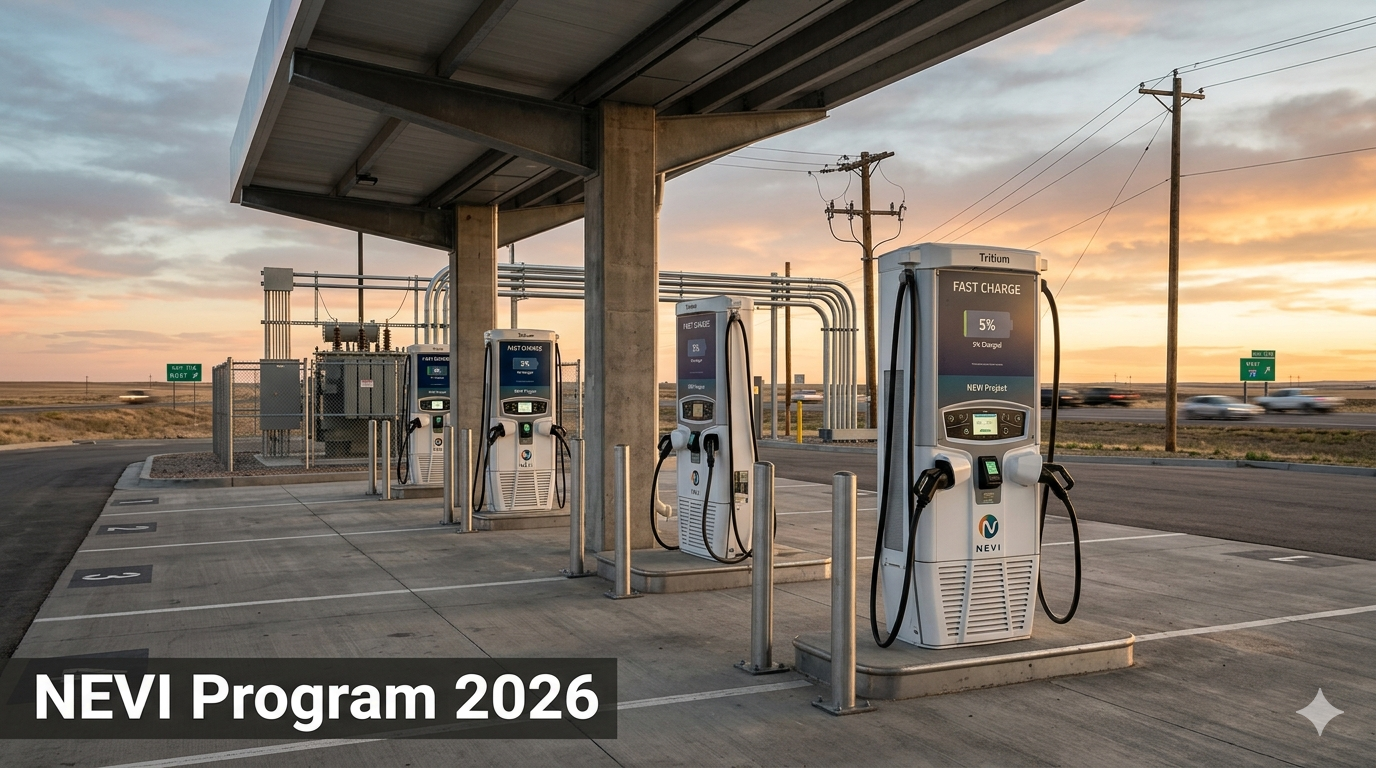
Understanding NEVI program requirements is essential if you manage commercial property, a vehicle fleet, or a public facility. The words “NEVI funding” have probably come up in meetings — and yet, most of the information out there is either written for policy wonks or buried in government PDFs.
This guide covers what you actually need to know. You’ll learn what the National Electric Vehicle Infrastructure (NEVI) program covers, what your property or project needs to qualify, what contractors must bring to the table, and where things stand in 2026 — including the funding freeze that was overturned and the updated technical requirements that took effect this year.
Understand the full cost of a commercial EV charging project
Contents
- 1 What Is the NEVI Program and How Does It Work?
- 2 What Are the NEVI Program Requirements to Qualify for Funding?
- 3 How Much Funding Does NEVI Provide?
- 4 Do Contractors Need EVITP Certification for NEVI Projects?
- 5 Which States Have Open NEVI Solicitations in 2026?
- 6 When Does NEVI Funding Expire?
- 7 Ready to Explore a NEVI Project for Your Property or Fleet?
- 8 Frequently Asked Questions
What Is the NEVI Program and How Does It Work?
The National Electric Vehicle Infrastructure (NEVI) Formula Program was established under the Infrastructure Investment and Jobs Act of 2021. It allocated $5 billion in federal funding — distributed to states through fiscal years 2022–2026 — with one core goal: build a nationwide network of publicly accessible, fast EV charging stations along designated highway corridors.
Unlike a grant program where individual property owners apply directly, NEVI works through state departments of transportation (DOTs). Each state receives an annual apportionment and must publish an EV Infrastructure Deployment Plan before accessing funds. States then issue solicitations to eligible project developers and installers.
For FY 2026, $885 million was apportioned and released in October 2025. As of late 2025, NEVI-funded stations were operational across the country, with many more projects in the pipeline as states scale their programs.
Key takeaway: NEVI money flows through your state DOT, not directly to property owners. However, you can qualify as a project site or partner with a developer who is applying for NEVI funding on your behalf.
What Happened to the 2025 Funding Freeze?
In early 2025, the federal government paused NEVI disbursements during a broader review of infrastructure spending. This created significant uncertainty across the industry. However, a federal court order overturned the freeze, and the program fully resumed in August 2025 — with updated guidance that actually expanded state flexibility in several specific ways.
The program is active, funded, and moving forward in 2026.
What Are the NEVI Program Requirements to Qualify for Funding?
NEVI has specific technical and operational requirements that sites and equipment must meet. These aren’t optional — they’re baked into the federal guidance and enforced through state solicitations. Here’s what matters for commercial property owners, parking facility operators, and fleet managers evaluating whether their site or depot qualifies.
Location Requirements
NEVI-funded stations must be located on the Alternative Fuel Corridor (AFC) network — federally designated highway corridors. Historically, sites needed to be within one mile of a highway exit and spaced no more than 50 miles apart along a corridor.
Important 2025 update: The 50-mile spacing rule was removed in the August 2025 guidance. States now have significantly more flexibility in where they place funded stations, which opens up more commercial sites that are near — but not directly on — major corridors.
Technical Requirements
Each NEVI-funded station must meet these minimum specifications:
- At least 4 DC fast charging (DCFC) ports per station
- Each port is rated at a minimum of 150 kW
- All ports are capable of operating simultaneously at full power
- NACS (J3400) connector compatibility is mandated by the majority of states, alongside CCS
- OCPP 2.0.1 compliance required as of 2026 (open protocol for charger-network communication)
- Payment accepted via credit/debit card — no app-only stations
These requirements effectively mean NEVI stations are DC fast chargers only. Level 2 chargers do not qualify for NEVI funding under the current rules.
Uptime Requirements
NEVI-funded stations must maintain 97% annual uptime per port. This is a significant operational commitment — it means no more than roughly 11 days of downtime per port, per year. Stations that fail to meet this threshold risk losing continued access to program benefits and may face penalties under state agreements.
This is why choosing an experienced contractor — one who offers ongoing maintenance and monitoring — matters so much for NEVI projects specifically. The uptime obligation doesn’t end at ribbon-cutting.
Property manager note: If you’re partnering with a developer on a NEVI project at your site, get the uptime obligations in writing and understand who is responsible for maintenance compliance.
How Much Funding Does NEVI Provide?
The NEVI program requirements around funding are straightforward: NEVI covers up to 80% of eligible project costs. That’s a substantial subsidy — but understanding what counts as “eligible” is critical for accurate project budgeting.
Eligible costs typically include:
- DCFC hardware and equipment
- Electrical infrastructure work (panel upgrades, transformer work, conduit)
- Site preparation and civil work
- Network management software and installation
- Permitting and inspection fees
- Signage and ADA compliance work
What’s generally not covered: ongoing operational costs, land acquisition, or routine maintenance once the station is commissioned.
The 20% match requirement can typically come from the project developer, the property owner, utility programs, or state supplemental funding, so in some cases, the out-of-pocket cost for a qualifying site can be very low. Work with your state DOT and a qualified contractor to model the actual financial structure for your specific project.
See full installation cost ranges for commercial EV charging projects
Do Contractors Need EVITP Certification for NEVI Projects?
The short answer: yes, in most states — and it’s becoming the de facto standard even where not formally required.
The Electric Vehicle Infrastructure Training Program (EVITP) certifies electricians specifically for EV charging installation. NEVI guidance strongly encourages — and many state solicitations formally require — that installation crews include EVITP-certified technicians.
Beyond the certification requirement, NEVI projects involve a level of technical complexity that most general electrical contractors simply aren’t equipped for: high-voltage DCFC equipment, OCPP 2.0.1 configuration, network commissioning, and coordination with utilities on transformer and service upgrades. Hiring an EVITP-certified contractor isn’t just a compliance checkbox — it’s the practical baseline for a project of this scale.
Workforce requirements: Several state solicitations also reference prevailing wage requirements for NEVI-funded work, which intersect with the federal Davis-Bacon Act for projects receiving federal funds. Confirm with your state DOT and contractor what labor compliance obligations apply to your project.
When vetting contractors for NEVI projects, ask specifically:
- Do they have EVITP-certified technicians on staff?
- Have they completed NEVI-funded projects before?
- Can they handle OCPP 2.0.1 commissioning and network setup?
Search for NEVI-qualified installation contractors near you
Which States Have Open NEVI Solicitations in 2026?
State deployment timelines vary significantly. Some states — particularly those that moved quickly on their EV Infrastructure Deployment Plans in 2022–2023 — are now in later rounds of solicitations or have already awarded the majority of their FY 2022–2025 apportionments. Others are still ramping up.
The most current state-by-state status is maintained by the Joint Office of Energy and Transportation and updated regularly. Key places to check:
- Your state DOT’s EV infrastructure page
- The AFDC Alternative Fuels Corridor map (afdc.energy.gov)
- The Joint Office EV Hub (driveelectric.gov)
A few practical notes for 2026: states that previously paused activity during the federal funding freeze have resumed solicitations, and the updated August 2025 guidance — with its relaxed location rules — has opened new site opportunities that didn’t exist under the original corridor rules.
If you’re evaluating a site or fleet depot for a potential NEVI project, the best first step is engaging your state DOT directly or working with a contractor who has established relationships with state program administrators.
When Does NEVI Funding Expire?
The current NEVI formula program runs through FY 2026, with the full $5 billion allocated across the five years. The $885 million in FY 2026 funds released in October 2025 represents the final tranche of the original program authorization.
This does not mean NEVI ends in 2026. State apportionments can be obligated (committed to specific projects) and then drawn down over subsequent years. Projects awarded in FY 2026 solicitations may not break ground until 2027 or later — and the funds follow those projects.
Bottom line: If you’re evaluating a NEVI-eligible project, 2026 is the year to move. Solicitation timelines, permitting, utility coordination, and construction don’t happen overnight — projects that get started now have the best chance of capturing remaining FY 2026 apportionments.
Ready to Explore a NEVI Project for Your Property or Fleet?
NEVI projects require contractors with specific experience — EVITP certification, DCFC installation expertise, OCPP 2.0.1 commissioning, and ideally a track record with state DOT programs. Not every electrician qualifies.
EVContractors.io is the only directory built specifically for commercial EV charging projects. Search by location, certification, and project type — and filter for contractors with NEVI and DCFC experience.
Search for NEVI-qualified installation contractors
Get matched with contractors experienced in NEVI projects — submit an RFQ
Frequently Asked Questions
What is the NEVI program and how does it work?
NEVI (National Electric Vehicle Infrastructure) is a $5 billion federal program that distributes funding to states to build public DC fast charging stations along designated highway corridors. States issue solicitations to project developers; property owners can participate as site hosts. NEVI covers up to 80% of eligible project costs.
What are the NEVI program requirements to qualify for funding?
Stations must include at least 4 DCFC ports (each 150 kW minimum), all capable of operating simultaneously. They must accept credit/debit payment, comply with OCPP 2.0.1, and offer NACS (J3400) connectors alongside CCS in most states. Stations must maintain 97% annual uptime per port. The 50-mile spacing requirement was eliminated in August 2025.
How much funding does NEVI provide per state?
Allocations vary by state based on a formula (highway lane miles, total lane miles, and vehicle miles traveled). Nationally, $5 billion is distributed across FY 2022–2026. FY 2026 saw $885 million apportioned. Individual project coverage is up to 80% of eligible costs.
Do contractors need EVITP certification for NEVI projects?
Yes — most state solicitations formally require EVITP-certified technicians for NEVI installation work, and those that don’t still strongly prefer it. NEVI-funded DCFC projects also involve OCPP 2.0.1 commissioning and utility coordination, which requires experienced commercial EV charging contractors beyond general electrical trades.
When does NEVI funding expire?
The current authorization runs through FY 2026, with the final tranche of $885 million released in October 2025. However, awarded project funds can be drawn down in later years. If your project might also qualify for the 30C federal tax credit for EV charging infrastructure, confirm the current deadlines and eligibility with a tax professional.